Dule Temple, Buddhist temple in Jizhou District, China.
Dule Temple is a Buddhist temple on Wuding Street in Jizhou District, Tianjin. Its two oldest structures are the front gate and the Guanyin Pavilion, both rebuilt in 984 during the Liao dynasty. The pavilion is a three-story timber building, about 23 meters tall, with a hidden middle story and 24 types of dougong brackets joined without nails. Inside stands a 16-meter clay statue of the eleven-headed Guanyin.
The temple's founding date is uncertain; Liang Sicheng placed it no later than the early Tang. In 755 An Lushan rallied troops here before rebelling against the Tang. The surviving gate and Guanyin Pavilion were rebuilt in 984, the second year of the Liao Tonghe era, when a new great hall was raised and the eleven-headed Guanyin was remodelled. The other halls date mainly from the Ming and later, and the Qianlong palace was added in 1753.
The temple's name, 'Solitary Joy', is popularly linked to An Lushan, who rallied his troops here in 755 before rebelling against the Tang; locals say he meant to keep joy for himself alone. The main gate's plaque is attributed to Ming official Yan Song, and the Guanyin Pavilion's lower plaque, signed 'Taibai', is traditionally ascribed to the Tang poet Li Bai.
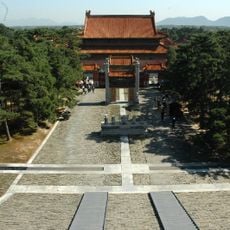
The temple stands at 41 Wuding Street in Jizhou District. The gate opens onto the courtyard, with the Guanyin Pavilion directly behind it; the Qing-dynasty palace buildings occupy the eastern section. The site has been open to the public since 10 May 1980. Visitors enter through the three arched doorways of the gate.
The ridge-end ornaments on the gate's roof, called chiwei, are the oldest surviving examples still in their original position in Chinese architecture. Look up at the ends of the main ridge to see these owl-tail-shaped pieces and the beast heads behind them.
The community of curious travelers
AroundUs brings together thousands of curated places, local tips, and hidden gems, enriched daily by 93,900 contributors worldwide.