White Pagoda of Ji County, Buddhist pagoda in Jizhou District, China.
The White Pagoda of Ji County is an octagonal brick-and-stone tower 30.6 m tall, 300 m south of Dule Temple, of which it was once part. Its base has granite courses below a brick imitation-wood Sumeru pedestal whose arched panels hold reliefs of dancing and music-playing figures. Above three brick eaves with bronze bells hang a dome, thirteen rings and a bronze finial.
Carbon-14 dating of wood in the structure places its origin in the Sui dynasty, over 1,400 years ago. It was rebuilt in 1058, the fourth year of the Liao Qingning era, in Liao style, and repaired under the Ming Jiajing, Longqing and Wanli emperors and the Qing Qianlong emperor. The 1976 Tangshan earthquake cracked the body throughout; a major reinforcement followed in 1983.
The pagoda's names record its past: it was called Yuyang Commandery Pagoda, and after a Guanyin temple was built in front of it in 1533 (Ming Jiajing 12), it became known as Guanyin Temple White Pagoda. Its south face has a door with a Buddha niche inside; the other three faces have brick false doors, and the four remaining sides carry reliefs of Buddhist verses reading "all phenomena arise from causes."
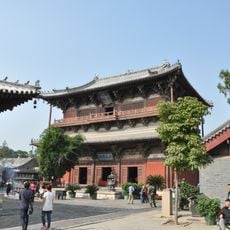
The pagoda stands in the southwest of Jizhou's urban area, about 300 m south of Dule Temple, on the same north-south axis as the temple's Guanyin Pavilion. It can be visited on foot from Dule Temple. The structure was damaged in the 1976 Tangshan earthquake and reinforced in 1983, so the brickwork seen today reflects that restoration.
Liang Sicheng surveyed the pagoda in 1932 and noted that from the Guanyin Pavilion of Dule Temple, the Buddha's gaze falls straight on it, suggesting the pagoda was placed on the temple's north-south axis as part of a city plan laid out a thousand years ago.
The community of curious travelers
AroundUs brings together thousands of curated places, local tips, and hidden gems, enriched daily by 93,400 contributors worldwide.