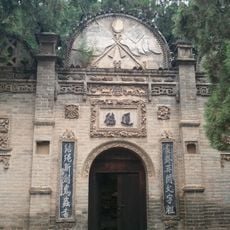
Five Dragons Temple, Tang dynasty Taoist temple in Ruicheng County, Shanxi, China
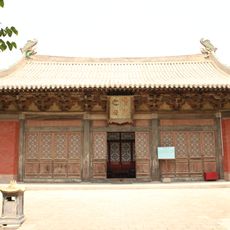
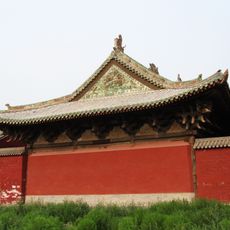
Five Dragons Temple is a 9th century structure in Ruicheng County featuring a main hall with five bays that displays traditional Tang dynasty timber construction methods. The building demonstrates the carpentry techniques of its era, with wooden joints precisely fitted together without metal fasteners.
The main hall was built in 832, in the sixth year of the Taihe era of the Tang dynasty, as recorded in the stele 'Longquan Ji' erected that same year. It is the second-oldest surviving Tang timber hall in China, after the main hall of Nanchan Temple (782). A stele of 808, 'Guangren Wang Longquan Ji', records magistrate Yu's channeling of the Longquan spring for irrigation.
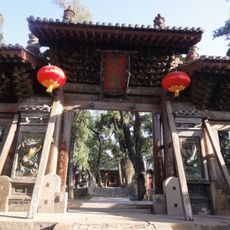
The temple is a folk rain-prayer shrine to Guangren Wang, the dragon-spirit of the Longquan spring that once welled up below the hall; locals also call it Wulong Miao, the Five Dragons Temple. Two Tang steles record a county magistrate's irrigation works and the temple's expansion; they are now set into the wall behind the hall.
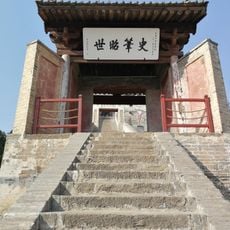
The temple stands in Zhonglongquan village, Gucheng town, north of Ruicheng, beside the present site of Yongle Palace. The main hall sits on a 1.2 m platform reached by steps, with no front terrace; the Qing stage and the hall are the surviving structures, the side rooms having gone. The hall reopened on 4 January 2015 after an 18-month restoration.
The main hall's bracket sets use a repeated arch-and-beam form of wall-supporting bracket found nowhere else among early northern Chinese buildings. Its rectangular, straight-ended inner-slot brackets preserve Han and Sui dynasty shapes, and the absence of a cantilevered beam frame supports the theory that hip-gable roofs developed from overhanging-gable and hip roofs.
The community of curious travelers
AroundUs brings together thousands of curated places, local tips, and hidden gems, enriched daily by 93,876 contributors worldwide.