Stork Tower, Ancient tower in Puzhou Town, Yongji, China
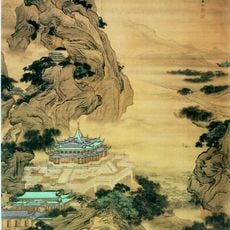
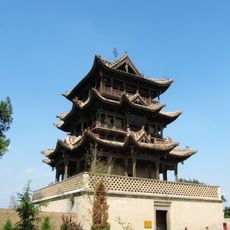
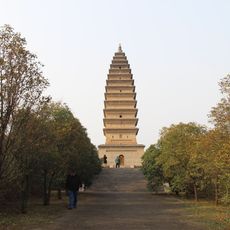
Stork Tower is a structure in Puzhou that stands about 74 meters tall and comprises three levels designed in Tang Dynasty style with elaborate decorative details. Each floor houses exhibition spaces showing different aspects of regional history and literary heritage.
Yuwen Hu, regent of the Northern Zhou, built the tower outside Puzhou as a military watchtower in the 6th century; it stood for about 700 years. It was destroyed by fire in 1222 during the Jin–Mongol struggle for Puzhou, and the site was buried by Yellow River floods in the Ming. The present tower was rebuilt from 1997 and opened in 2002.
The tower takes its name from storks that often perched on it, as recorded in historical accounts. Wang Zhihuan's five-character quatrain "On the Stork Tower," written around 704, made it famous; the poem is still taught and recited. Inside, a bronze statue of the poet stands, and the first floor displays Mao Zedong's calligraphy of the poem, of which six manuscripts survive.
The rebuilt tower stands in Puzhou Town, Yongji, at the junction of Shanxi, Shaanxi and Henan, near the old Pujin Ferry site outside Puzhou's west gate. Inside, six storeys rise behind the four-eave, three-tier exterior, with spiral stairs in the east and west corners. The surrounding scenic area covers 2.064 square kilometres, so allow time to walk between the tower and the old city walls.
The tower's name comes from the storks that perched on the original structure, and the rebuilt tower holds a bronze statue of Wang Zhihuan, whose poem made it famous. The tower also appears as a filming location in the game Black Myth: Wukong.
The community of curious travelers
AroundUs brings together thousands of curated places, local tips, and hidden gems, enriched daily by 93,898 contributors worldwide.