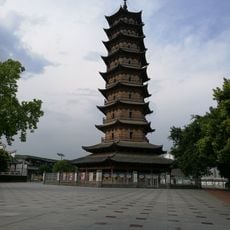
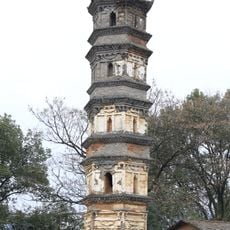
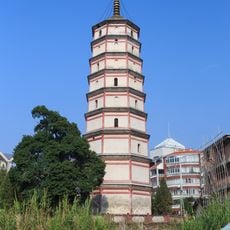
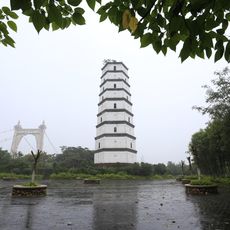
Sanying Pagoda, Buddhist pagoda in Nanxiong, China.
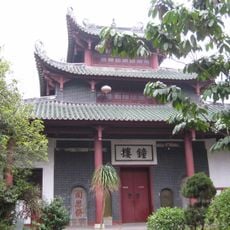
Sanying Pagoda is a brick tower with traditional Chinese architectural features, standing in the historic district of Nanxiong. The structure displays characteristic layers and decorative elements typical of Buddhist religious buildings.
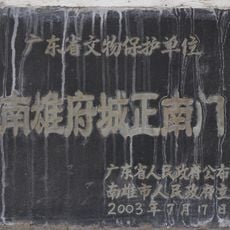
Sanying Pagoda was completed in 1009, the second year of the Dazhong Xiangfu era of the Northern Song. It stood beside Yanzxiang Temple, which later fell into ruin while the pagoda survived; the largest of its successive repairs was in 1446, the eleventh year of the Ming Zhengtong era. After 1949 the pagoda was restored in the 1980s, and in 1988 it was listed as a Major Historical and Cultural Site Protected at the National Level.
The name Sanying, "three shadows", comes from a legend that the newly built pagoda cast three shadows, two hanging downward and one pointing up. Residents built a Sanying Tang hall where the shadows fell and read their position to foretell fortune; the hall is gone and its site unknown. The tower was also called Yanxiang Temple Pagoda after the adjacent temple, which has since vanished while the pagoda survived.
Sanying Pagoda stands on Yongkang Road in the Xiongzhou subdistrict of Nanxiong, Shaoguan, Guangdong. The brick tower rises 50.2 m in nine visible storeys over eight hidden inner levels, with a 1.78 m waist-summoned base. A climb passes through hexagonal chambers and brick stairs; the iron finial tops the structure.
The pagoda's name comes from a legend that it once cast three shadows: two hanging downward and one pointing upward. Locals built a hall called Sanying Tang where the shadows fell and read their position to predict fortune; the hall is gone and its site is unknown.
The community of curious travelers
AroundUs brings together thousands of curated places, local tips, and hidden gems, enriched daily by 94,465 contributors worldwide.