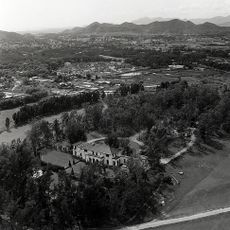
Lady Ho Tung Welfare Centre, Grade II historic building in Sheung Shui, Hong Kong.
Lady Ho Tung Welfare Centre consists of two single-storey buildings designed in a Western Arts and Crafts style with Chinese tiled roofs, a combination rarely seen in Hong Kong. The entrance bears the inscription "Lady Ho Tung Welfare Centre" in Chinese characters.
Built between 1932 and 1933 and opened in 1934, the centre was named after Margaret MacLean, Sir Robert Ho Tung's first wife; the entrance bears the inscription "Lady Ho Tung Welfare Centre". It served as a maternal and infant centre and a convalescent home for Indian soldiers until 1973, and in 1948 a specialist ward was added for police stationed in the New Territories. Outpatient services stopped in July 2005 after roof tiles collapsed, and the centre closed on 11 June 2013.
The building mixes Western Arts and Crafts design with Chinese features, visible in how the roof curves and how the courtyards are laid out.
The centre closed on 11 June 2013 and the site was returned to the government. It is not open to the public; the two single-storey blocks and their tiled roofs are best seen from Kut Shing Road beside the Kut Shing Market. A revitalisation into an ecology study centre was scheduled to finish in 2020.
The building's name is written at the entrance as "何東麥夫人醫局" (Lady Ho Tung, née Mak, Welfare Centre), honouring Ho Tung's first wife, Mak Sau-ying. From 1932 to 1973 the centre also served as a convalescent home for Indian soldiers, a fact not evident from its clinic appearance.
The community of curious travelers
AroundUs brings together thousands of curated places, local tips, and hidden gems, enriched daily by 94,051 contributors worldwide.