Sheshan Observatory, Astronomical observatory in Songjiang, China.
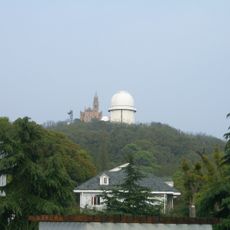
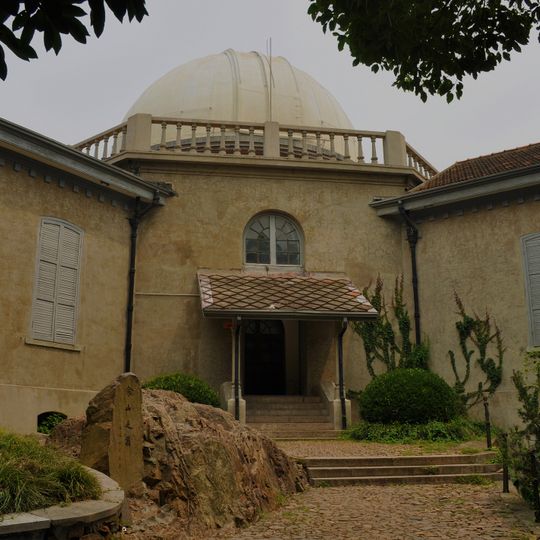
Sheshan Observatory is a two-storey European-style reinforced concrete building shaped like a cross, 4,148 square metres in total, on the summit of West Sheshan. Its 10-metre steel-framed dome, clad in aluminium alloy and weighing 150 tonnes, rotates through 360 degrees and shelters a 40 cm double refractor made by Gautier of Paris in 1899. A meridian room with a 6 cm transit instrument adjoins the dome, and the fireplace and library keep their original layout.
French Jesuits founded the station in 1899 as one of China's first centers for this kind of research. Over the 20th century the site grew and eventually combined forces with another observatory to strengthen its scientific work.
The observatory's name comes from Sheshan Hill, where it stands beside the Sheshan Catholic Church. Its first director, the French Jesuit priest Cai Shangzhi (Stanislas Chevalier), served from 1901 to 1925, and staff were mostly foreigners in that era. From 1907 it published the Sheshan Observatory Annals, which ran to 21 volumes before stopping in 1942 for lack of funds.
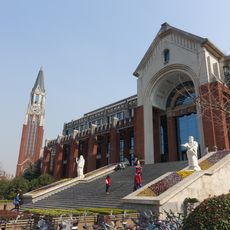
The observatory stands on the summit of West Sheshan, beside the Sheshan Catholic Church, in Songjiang District. The site is reached on foot via the paths of West Sheshan Park, which opened in 1995. The building has been open to visitors since 1987 and houses the Shanghai Astronomical Museum since 2004; it reopened in 2023 after two years of restoration.
The 40 cm double refractor was made in Paris by Gautier in 1899. In its first 25 years staff took over 12,000 solar photographs and drew more than 7,000 sunspot sketches, and in 1910 they photographed Halley's Comet. The observatory also holds China's largest collection of astronomical photographic plates.
The community of curious travelers
AroundUs brings together thousands of curated places, local tips, and hidden gems, enriched daily by 93,849 contributors worldwide.