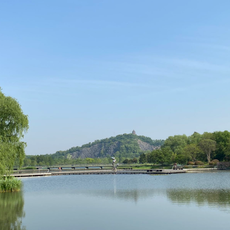
Huzhu Pagoda, Leaning pagoda on Tianmashan Hill, Songjiang District, China.
Huzhu Pagoda is an octagonal, seven-storey brick tower on the summit of Tianmashan Hill in Songjiang. It leans to the southeast, measured at 6.51 degrees in 1982 and 7.10 degrees in 2015, with its top displaced 2.27 metres from true vertical. The lean stems from a foundation split between bedrock and stone ballast.
The tower was built in 1079 during the Northern Song Dynasty as a Buddhist monument. A destructive fire in 1788 damaged much of its wooden framework and interior spaces, changing the structure fundamentally.
The pagoda was originally part of a temple complex; in 1157 relics granted by Emperor Gaozong of Song were placed inside, giving it the name Huzhu Baoguang Pagoda. It was repaired in 1245. In 1788 fireworks set off at a rite at the nearby Yuanzhi Temple burned the pagoda, leaving only the brick body.
The pagoda sits on a hill that is fairly easy to reach by local transport and accessible on foot once you arrive. There is open space around the tower for viewing it from different angles without obstacles.
The 1788 fire that destroyed the wooden parts started during a fireworks display at a ceremony at the nearby Yuanzhi Temple. Afterwards people dug bricks out of the base to get at coins in the joints, leaving a hole about 2 metres across and removing a third of the foundation stones, which is what set the tower leaning.
The community of curious travelers
AroundUs brings together thousands of curated places, local tips, and hidden gems, enriched daily by 93,990 contributors worldwide.