Yongling Mausoleum, Imperial mausoleum in Liaoning, China
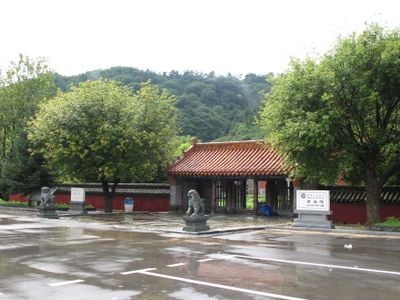
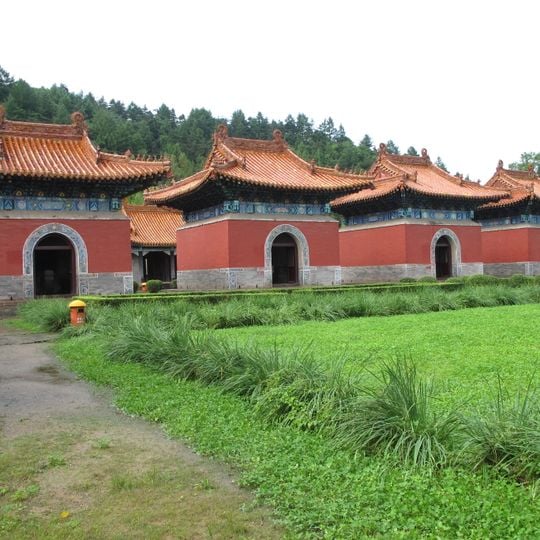
Yongling Mausoleum, originally Xingjingling, lies at Yongling Town in Xinbin Manchu Autonomous County, Fushun, Liaoning. Its 800-metre spirit path leads to the wooden-fenced Zhenghong Gate, then to four stele pavilions for the ancestors Mengtemu, Fuman, Giocangga and Taksi, and on to Qiyun Gate and Qiyun Hall. Behind lies the treasure city with the graves, arranged by generation.
Built in 1598, the mausoleum holds the remains of Nurhaci's ancestors from the early Qing period. The site marks a turning point in Chinese history as its rulers were establishing their new dynasty.
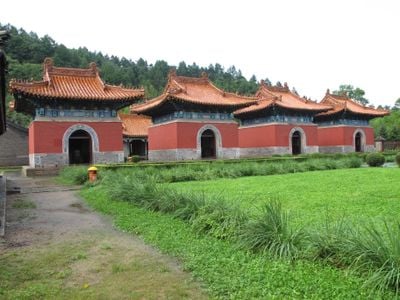
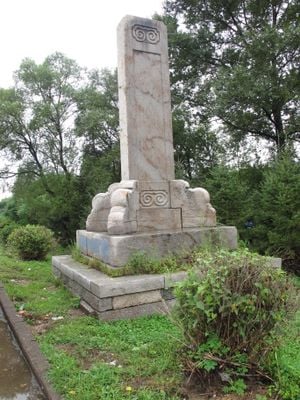
The four stele pavilions of the ancestral emperors are arranged by the zhaomu principle: Zhaozu left of centre, Xingzu right of centre, Jingzu far left, Xianzu far right. Their steles praise the ancestors in Manchu, Mongolian and Chinese. The brick reliefs on the side walls behind Qiyun Gate show cloud dragons carved in brick, not glazed tile.
The 800-metre spirit path leading to the site has no stone statues or ornamental columns; its entrance is marked by a dismounting stele erected in 1783. The main gate, Zheng Hong Men, is closed with a wooden palisade rather than solid doors, a Manchu feature. Inside, the four stele pavilions are arranged by generation: facing the gate, Zhaozu stands centre-left, Xingzu centre-right, Jingzu far left and Xianzu far right.
The brick-vaulted burial chambers are tiny: when the tombs of Prince Wugong and Prince Keqin were excavated in 1981, each vault measured less than one cubic metre and held only a covered-jar urn of ashes, with no grave goods. The main tombs are thought to be similar or slightly larger.
The community of curious travelers
AroundUs brings together thousands of curated places, local tips, and hidden gems, enriched daily by 93,898 contributors worldwide.