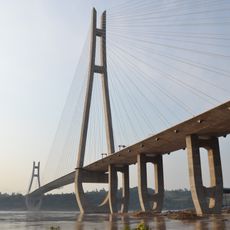
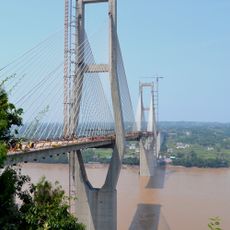
Bosideng Bridge, Arch road bridge in Hejiang County, China
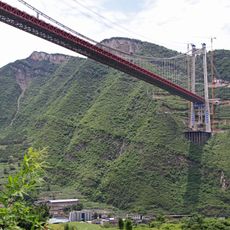
The Bosideng Bridge is a concrete-filled steel tubular arch bridge over the Yangtze in Hejiang County, Sichuan. Its two parallel box trusses, each made of four 1.3-metre tubes, taper from 16 metres at the springings to 8 metres at the crown. The 530-metre arch carries a 28.6-metre-wide four-lane deck, and prestressed concrete viaducts bring the total length to 831 metres.
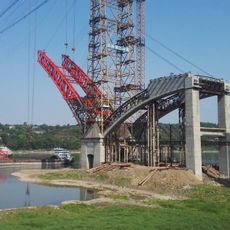
Planned as Hejiang Bridge 1 for the G93 expressway near Rongshanzhen, the crossing was chosen over suspension and steel-arch designs because a concrete-filled steel tube arch needed the least steel. Its 530 m span surpassed the 460 m Wushan Yangtze Bridge, then the longest of its type. The arch was closed by cantilever construction using two 148 m temporary towers tied back with rock anchors up to 50 m deep.
The name comes from the Chinese sportswear firm Bosideng, which sponsored the crossing; locally it is also known as the Hejiang Yangtze River Bridge No. 1, the working name used while three designs were compared. Drivers on the G93 cross it between Luzhou and Chongqing, and a second, similar bridge a few kilometres upstream is often mistaken for it.
The bridge carries vehicles on the G93 Expressway and serves as the main link between Hejiang County and surrounding areas. The modern structure allows steady traffic flow throughout the year.
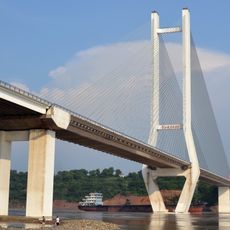
The bridge can be confused with the Hejiang Yangtze River Bridge a few kilometres upstream. Its 530 m arch was built by cantilevering 40 segments lifted by cable cranes; the heaviest weighed 197 t and was 40 m long.
The community of curious travelers
AroundUs brings together thousands of curated places, local tips, and hidden gems, enriched daily by 93,811 contributors worldwide.