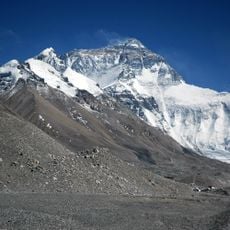
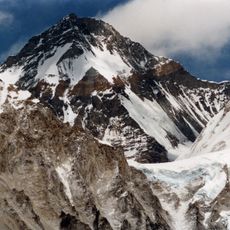
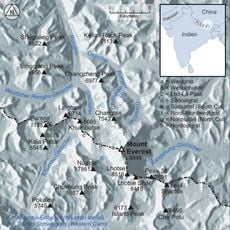
South Summit, Mountain peak in Tibet Autonomous Region and Nepal.
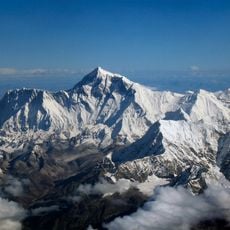
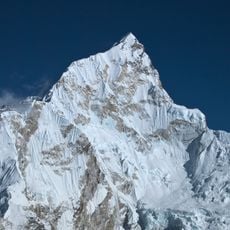
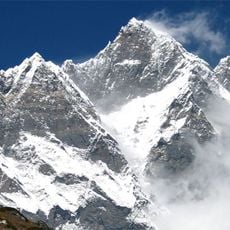
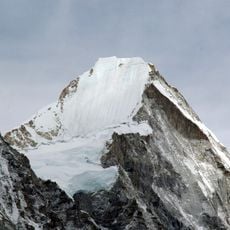
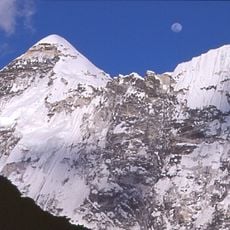
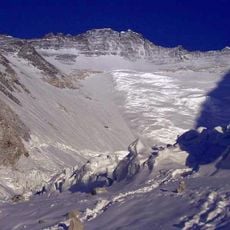
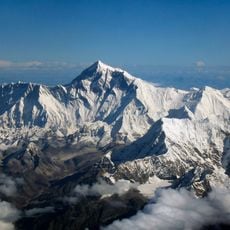
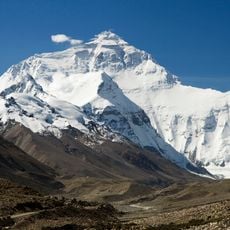
The South Summit is a dome-shaped peak of snow and ice on Mount Everest, standing at 8,749 metres, about 100 metres below and 130 metres from the main summit. It connects to the main summit via the Cornice Traverse and Hillary Step. Its topographic prominence is only 11 metres, so it is not counted as a separate mountain.
Charles Evans and Tom Bourdillon of the 1953 British expedition reached the South Summit on 26 May 1953 at 1 pm, but Evans' oxygen set stopped them continuing. Three days later Edmund Hillary and Tenzing Norgay crossed it on the way to the main peak. In 1965 an Indian expedition geologist found seashell fossils in limestone about 100 feet above it.
Climbers commonly pause here to change oxygen bottles or turn back, and in clear weather the Cornice Traverse, the Hillary Step and the main summit come into view. John Hunt, reaching the South Col in 1953, called it "an elegant snow spire". Rob Hall's body remains on the South Summit after the 1996 blizzard.
Climbers at this elevation must carefully monitor weather conditions and available resources such as oxygen, as there is little time for rest. Good planning is essential to decide whether continuing is safe.
During the 1965 Indian Everest expedition, a geologist found a deposit of fossilised seashells in limestone about 100 feet (30 m) above the South Summit. The find places marine fossils on the upper mountain itself, not merely nearby. Rob Hall's body has remained on the South Summit since he died there on 11 May 1996.
The community of curious travelers
AroundUs brings together thousands of curated places, local tips, and hidden gems, enriched daily by 94,042 contributors worldwide.