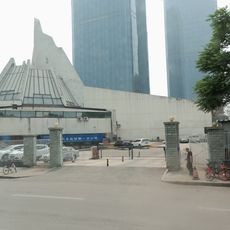
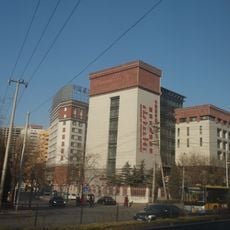
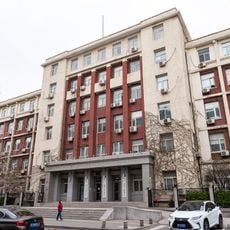
Chinese Academy of Cultural Heritage, Cultural institution in Xiaoguan, China.
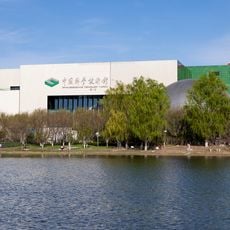
The Chinese Academy of Cultural Heritage is a research facility with seven departments dedicated to scientific study and preservation of cultural artifacts. The institution houses specialized laboratories, archives, and training programs for heritage professionals.
Founded in 1935 as the Old Capital Cultural Relics Reorganization Committee under the Executive Yuan's Ping Political Affairs Committee, it was renamed the Beijing Cultural Relics Reorganization Committee in 1949 and placed under the Ministry of Culture's Cultural Relics Bureau. It became the Ancient Architecture Restoration Institute in 1956, merged with the Museum Science Research Institute Preparatory Office in 1962 to form the Cultural Relics and Museums Research Institute, and was renamed the Institute of Cultural Relics Protection Science and Technology in 1973. After merging with the Ancient Documents Research Office in 1990 it became the China Institute of Cultural Relics, and in 2007 it took its present name, with the new name formally unveiled the following year.
The academy's name dates only from 2007, when the Institute of Cultural Relics of China was renamed; the present title was formally unveiled in 2008. Its remit covers research, conservation, restoration and training, and it hosts the secretariat of the ICOMOS China National Committee. Staff have received foreign honours, including the Netherlands' Prince Claus Award and Cambodian knighthoods.
The academy is a working research institute under the National Cultural Heritage Administration, not a public museum, and the sources describe no visitor access. Its laboratories, library and training programmes serve staff and invited professionals. Those with scholarly business should contact the institute in Xiaoguan in advance rather than expect walk-in entry.
The academy has shared its expertise beyond China and deployed its specialists on preservation projects worldwide, including work in Cambodia. This international collaboration shows how Chinese knowledge contributes to global monument protection.
The community of curious travelers
AroundUs brings together thousands of curated places, local tips, and hidden gems, enriched daily by 93,136 contributors worldwide.