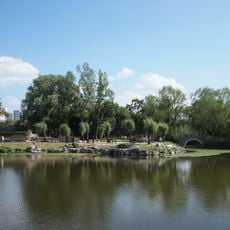
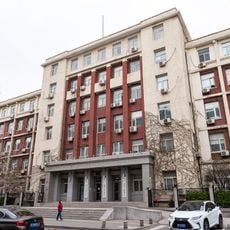
Beiding Niangniang Temple, Taoist temple in Olympic Green, China.
The Beiding Niangniang Temple is a Taoist shrine composed of several interconnected halls decorated with detailed carvings and ornamental designs on walls and pillars. The layout follows traditional Chinese temple design, with interior spaces containing religious statues and ritual objects used in daily worship.
The temple was founded during the Xuande era of the Ming Dynasty and rebuilt by imperial order under the Qianlong emperor of the Qing. It originally had four courtyards and five halls, with a large stage in front. After decline in the Republican period and severe damage during the Cultural Revolution, only the gate hall, second hall and bell tower remained. In 2006 it was rebuilt, and the National Swimming Center was relocated to spare it before the 2008 Olympics.
The temple is one of Beijing's Five Peaks, dedicated to Bixia Yuanjun along with Yanguang Niangniang, Zisun Niangniang, the Eastern Peak Emperor, the Jade Emperor, Guandi and the Medicine King. The Yanjing Suishi Ji records a temple market held every April, where everyday farm tools were sold and most visitors were villagers. Since 2006 the temple has operated as a branch of the Beijing Folk Museum.
The temple is located on North Fourth Ring Road and welcomes visitors throughout the day to explore multiple halls and observe religious ceremonies. Being respectful during active prayers and offerings is important, as this remains a living place of worship rather than a museum.
The temple is one of Beijing's Five Peaks (Wuding), each dedicated to Bixia Yuanjun. Before the 2008 Olympics, the National Swimming Center project nearly caused its demolition; the swimming center's siting was altered to spare the temple, which was then restored in 2006.
The community of curious travelers
AroundUs brings together thousands of curated places, local tips, and hidden gems, enriched daily by 93,942 contributors worldwide.