Blauer See, Artificial quarry lake in Harz District, Germany
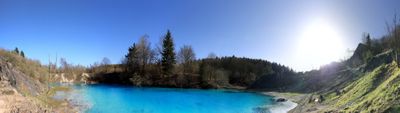
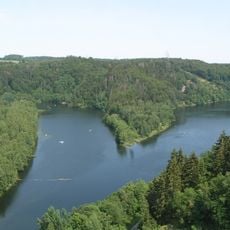
Blauer See is an artificial lake between Hüttenrode and Rübeland in the Harz, near the B 27. It fills the former Am Garkenholz limestone quarry, worked from 1885 for quicklime; a ring kiln survives by the shore. The lake is up to 6 m deep and fed by karst springs. Its water is oversaturated with calcium, which encrusts suspended particles and algae so they sink.
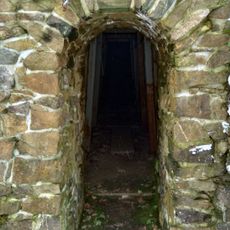
The lake occupies a former limestone quarry at Am Garkenholz, worked since 1885 to produce quicklime. Mining ceased after World War II, when lime ash was dumped into the open pit; operations ended for good in 1955 and the plants were dismantled. A ring kiln remains near the shore, while the shaft kiln was completely demolished.
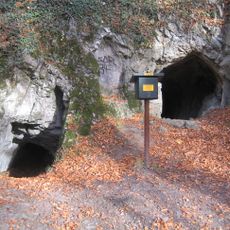
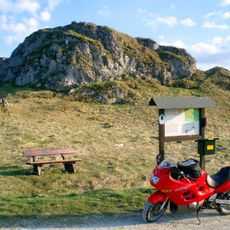
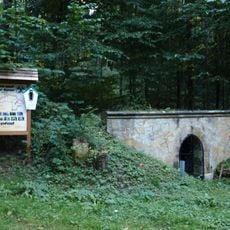
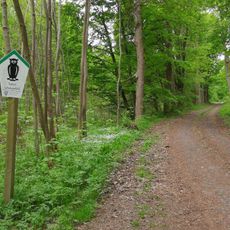
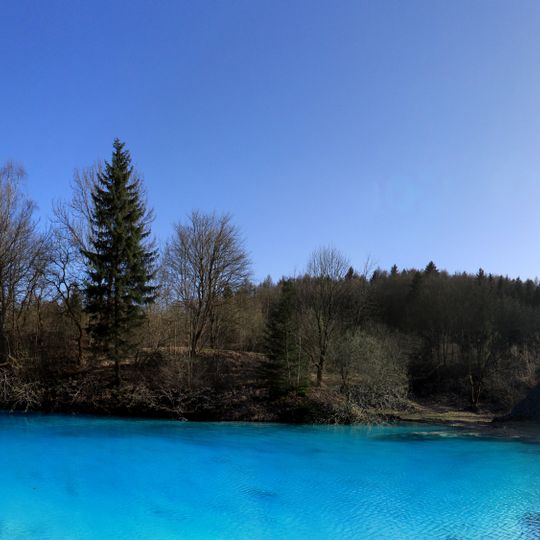
The lake is a designated geotope (no. 4231/2) and a Geopunkt of the Geopark Harz – Braunschweiger Land – Ostfalen, with an information board set up near the shore. Its German name, Blaue See, refers to the bright blue colour the water takes on in spring.
The lake lies between Hüttenrode and Rübeland, just off the B27, and is a designated geotope (no. 4231/2) with an information board nearby. Water seeps through cracks in the limestone in summer and autumn, so the basin can dry out towards winter and refill in spring. Check the water level before planning a visit.
The lake's blue colour comes from calcium carbonate: the karst-spring water is supersaturated with calcium, which precipitates and encrusts suspended particles and algae so they sink, leaving clear water that looks bright blue in spring. In summer, as spring discharge drops and algae increase, it turns green.
The community of curious travelers
AroundUs brings together thousands of curated places, local tips, and hidden gems, enriched daily by 93,713 contributors worldwide.