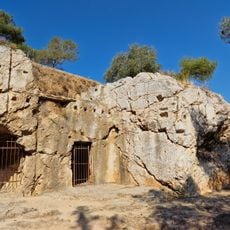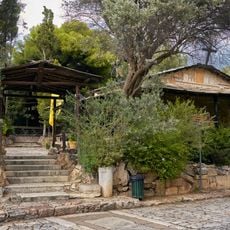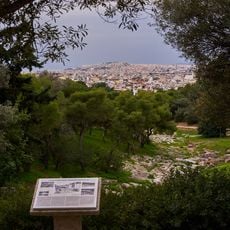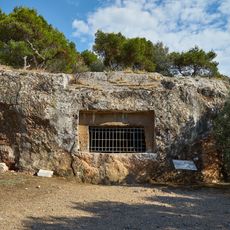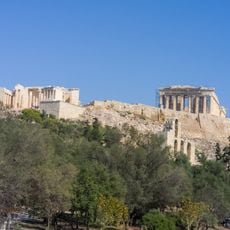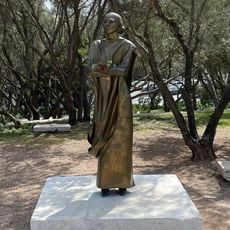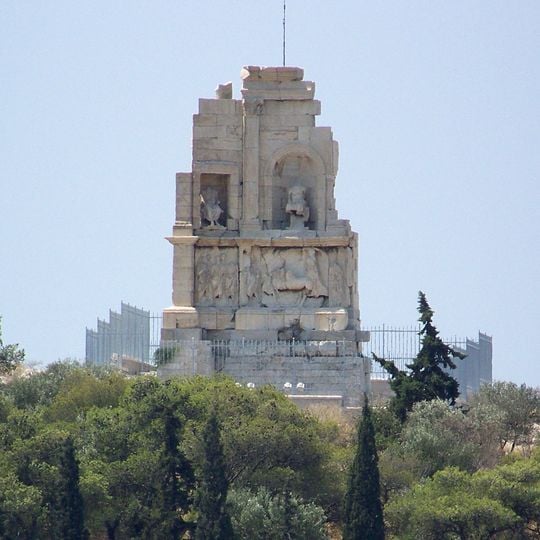
Philopappos Monument, Ancient mausoleum on Mouseion Hill, Athens, Greece.
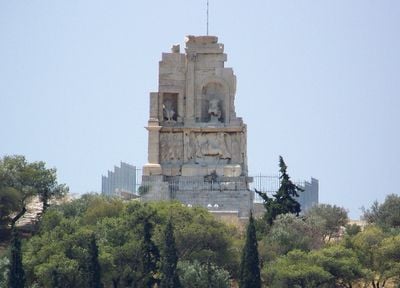
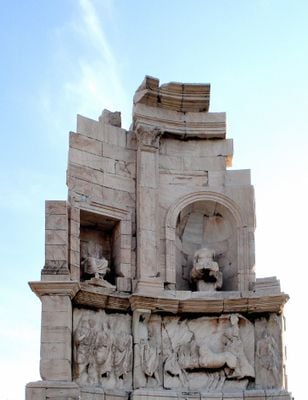
Philopappos Monument is a two-story mausoleum of white Pentelic marble on a 3.08-metre socle of porous stone veneered with Hymettian marble, measuring 9.80 by 9.30 metres. Its surviving northeast face has a frieze showing Philopappos as consul in a chariot led by lictors, above which three niches held statues of Antiochus IV, Philopappos and Seleucus I Nicator.
Philopappos died in 116 AD, and his sister Julia Balbilla, the last surviving member of the family, erected the tomb with the citizens of Athens on Mouseion Hill. The monument was built between 114 and 116 AD, during Roman rule, possibly within the city walls, where burial was normally forbidden. It was intact in 1436, when the traveler Cyriacus of Ancona visited it; its destruction came later.
Philopappos took the Athenian name "Philopappos, son of Epiphanes, of the deme of Besa", carved in Greek in the central niche, while a Latin inscription lists his Roman titles as consul and Arval brother. His sister Julia Balbilla, a poet, led the tomb's dedication with the citizens of Athens. Pausanias, who called it a monument built for a Syrian man, noted it stood where the seer Musaeus was said to be buried.
The site is free to visit and accessible year-round via a walking path from Dionysiou Areopagitou Street on the lower slopes. The uphill walk takes some effort, so allow time and wear comfortable shoes for the climb.
The central niche's Greek inscription reads "Philopappos, son of Epiphanes of the deme of the Besa", the name he used as an Athenian citizen. A Latin text in the left niche lists his Roman posts: consul, Arval brother and praetorian rank granted by Trajan. A third, Greek inscription naming him King Antiochus Philopappos survives only as its base.
The community of curious travelers
AroundUs brings together thousands of curated places, local tips, and hidden gems, enriched daily by 93,394 contributors worldwide.