Ros De Saint-Crod, Prehistoric cave with engraved art in Les Eyzies, France.
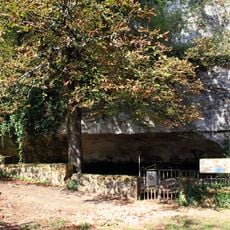
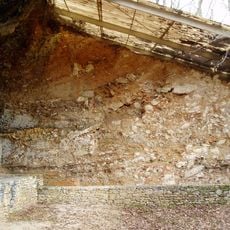
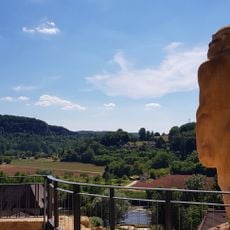
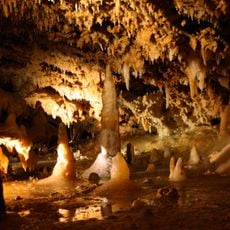
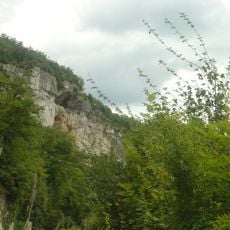
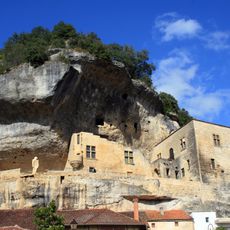
The grotte de Saint-Cirq, also called the Sorcerer's Cave, is a small cave with a rectangular to trapezoidal plan, 13 m long and five to six metres wide, cut into a Turonian limestone cliff above the right bank of the Vézère. Its floor was lowered when the cave served as a wine cellar. It holds 15 mostly incomplete engravings, including the figure André Glory named the Sorcerer, placed on a bulge of the ceiling at the very back.
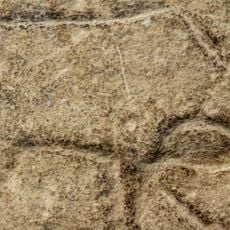
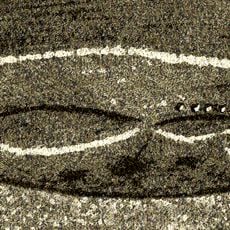
Engravings were recognised in 1952, when owner Noël Brousse invited prehistorian Bernard Mortureux and his wife into the cave on 22 May; they identified deeply cut horses and a bas-relief bison. André Glory recorded the figures the following year, and Brigitte and Gilles Delluc published a study in 1981. The cave was listed as a monument historique in 1958 and inscribed on the UNESCO World Heritage list in 1979 with the Vézère Valley sites.
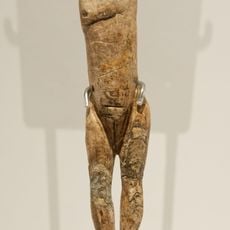
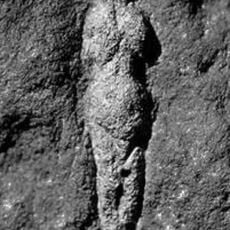
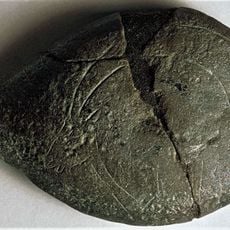
The cave is also called the Sorcerer's Cave after the human figure André Glory named "the sorcerer", engraved on a bulge of the ceiling at the very back. That figure is surrounded by an ibex, a bison, a wild horse, a triangular sign and two other human profiles. A small carved tortoise statuette is another notable piece.
The cave is closed to the public for an indefinite period since 2024, after the State bought the site in November 2024; reopening is envisaged around 2027 once the cliff is secured. Access is via the D 47 road between Les Eyzies and Le Bugue. A small museum near the cave displays finds from Saint-Cirq.
The cave holds 15 mostly incomplete engravings, among them a small turtle statuette and the figure André Glory named "the sorcerer", carved on a bulge of the ceiling at the very back. The sorcerer is surrounded by an ibex, a bison, a wild horse, a triangular sign and two human profiles.
The community of curious travelers
AroundUs brings together thousands of curated places, local tips, and hidden gems, enriched daily by 94,418 contributors worldwide.