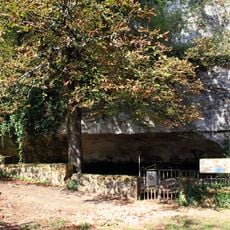
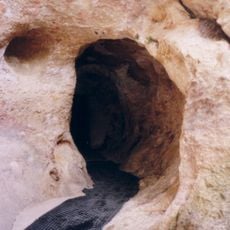
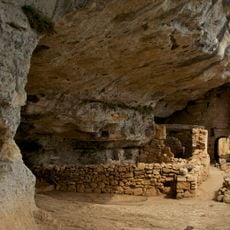
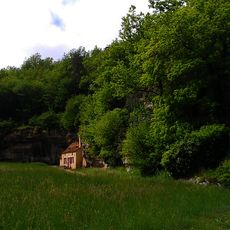
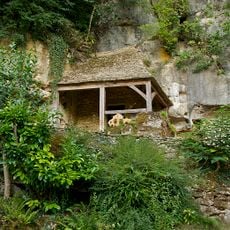
Grotte du Grand Roc, Natural cave in Les Eyzies, France
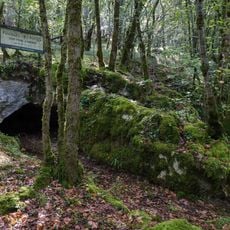
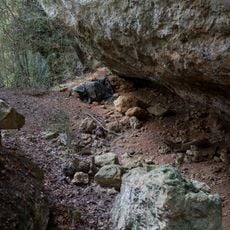
The Grotte du Grand Roc is a natural cave near Les Eyzies with impressive limestone walls that contain stalactites, stalagmites, and crystalline structures spread across different chambers. These formations developed over millions of years as water slowly worked through the stone to create the galleries and passages seen today.
The cave was discovered in 1924 by Jean Maury while he was researching the nearby prehistoric site of Laugerie-Basse. This find added greatly to knowledge of the geological history in the Vézère Valley region.
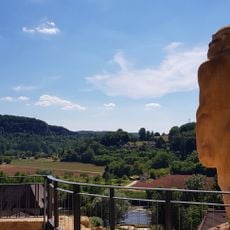
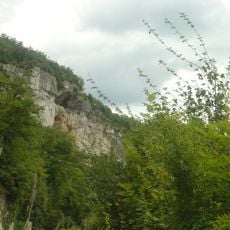
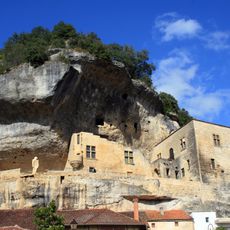
The cave's name comes from the limestone cliff of Grand Roc above the Vézère's right bank. It has no known prehistoric occupation, unlike the decorated caves nearby, and was listed by UNESCO in 1979 among the fifteen Vézère Valley sites; a 2014 report nonetheless proposed removing it as not emblematic. Its calcite triangles, hollow and equilateral, are rare in French show caves.
The cave maintains a steady temperature around 13 to 14 degrees Celsius year-round, so visitors should bring warm clothes. The paths through the chambers can be uneven and narrow, so sturdy shoes and some agility are needed.
The cave holds calcite triangles, hollow in the centre and equilateral, formed by trigonal crystallisation in a small pool that has since dried up. They are rare in French caves open to visitors, with only a few other examples such as the Gouffre de Proumeyssac in the Dordogne.
The community of curious travelers
AroundUs brings together thousands of curated places, local tips, and hidden gems, enriched daily by 95,306 contributors worldwide.