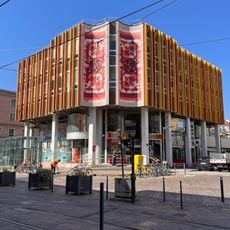
Halle Sainte-Claire, Covered market hall in central Grenoble, France.
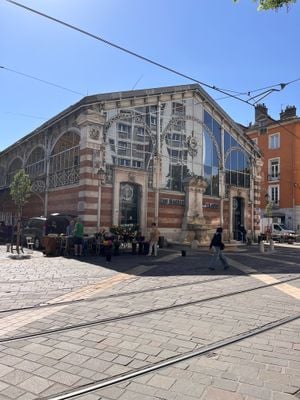
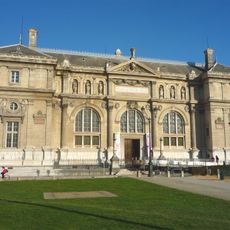
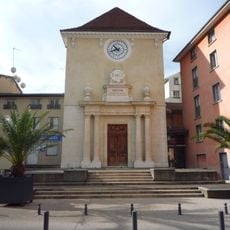
Halle Sainte-Claire is a covered market hall on place Sainte-Claire in the old centre of Grenoble, designed by local architect Hector Riondel and inspired by the Baltard halls of Paris. Its single roof rests on cast-iron pillars, so the brick walls are not load-bearing. The facade carries mascarons and corner acroteria shaped as lions' heads, and a lantern with wooden louvres tops the roof.
The city bought the land of the former Sainte-Claire convent in 1820 to open a square, and a market with a modest hall and a fountain followed in 1825 and 1830. Its success led to a new building by local architect Hector Riondel in 1874, inspired by the Baltard halls of Paris. The hall was renovated in the early 1990s and inscribed as a monument historique on 23 May 2007.
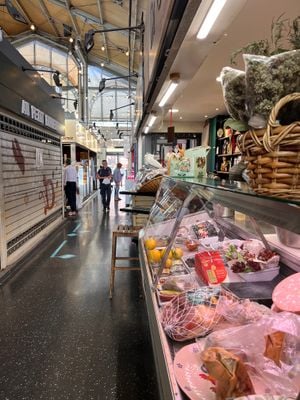
The name refers to the former convent of Sainte-Claire, whose land the city bought in 1820 to open a square; a market followed in 1825. The hall still hosts a municipal market within Grenoble's pedestrian shopping sector, and the tram stop is called Sainte-Claire-les Halles, in the plural, though there is only one building.
The market is best visited in early morning when selection is largest and the hall is less crowded. Comfortable shoes are recommended since moving between stands requires considerable walking.
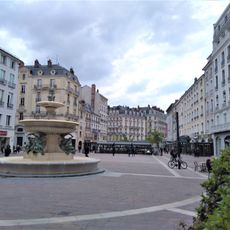
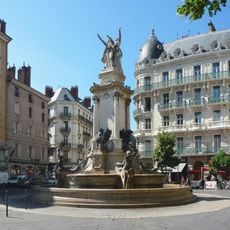
The fountain against the hall's gable was carved in Villebois stone by the sculptor Clauses in 1874. It shows a fish ringed by sun rays, and three roses at the top stand for the powers of the medieval city, which still appear on Grenoble's coat of arms.
The community of curious travelers
AroundUs brings together thousands of curated places, local tips, and hidden gems, enriched daily by 92,794 contributors worldwide.