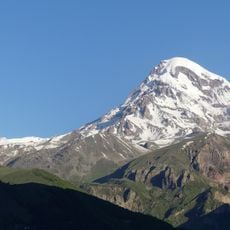
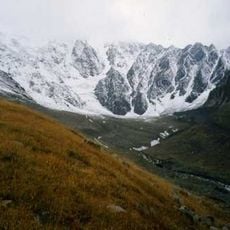
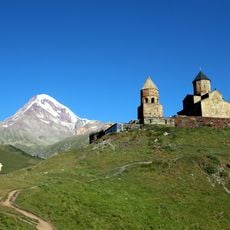
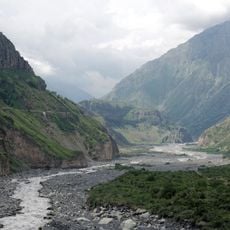
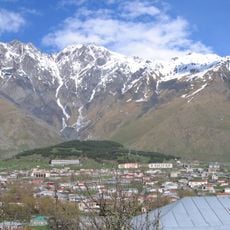
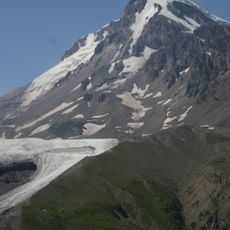
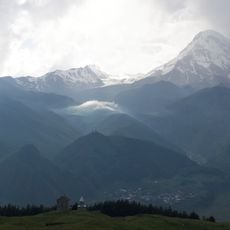
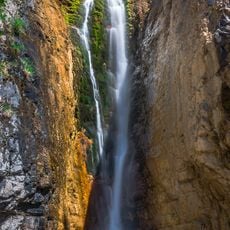
Cave of Bethlehem, Cave church on Mount Kazbek, Georgia
The Cave of Bethlehem is an early Christian cave temple located on Mount Kazbek at an elevation of approximately 4100 meters (13,450 feet). The interior features a dome-shaped vault with curved walls and a floor paved with square tiles.
The site dates to the 6th century and represents one of the earliest Christian places of worship in this mountain region. Archaeological finds including monks' cells, carved stone crosses, and stone pillars confirm its use as a monastic center.
Local tradition holds that the cave once contained Christ's manger and Abraham's tent, which stood without pillars or ropes, as Vakhushti Batonishvili recorded in the 18th century. Khevsurs regard the site as the limit of Saint George, from where he comes to people's aid. The cave also inspired Ilia Chavchavadze's 1883 poem The Hermit.
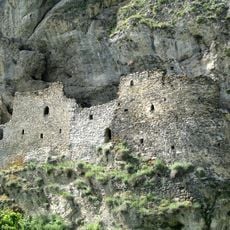
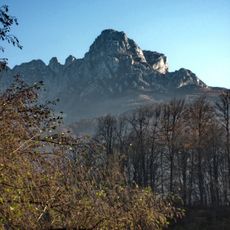
The entrance is cut into a steep reddish andesite cliff 300 to 400 metres above its base, on the Bethlehem ridge southeast of Kazbek. The 5.5-metre iron chain found at the entrance in 1948 is now kept in the Aleksandre Kazbegi Museum in Stepantsminda. The cave floor is paved with square tiles and the vault is dome-shaped, so the interior is cramped and uneven.
Vakhushti Bagrationi noted in the 18th century that a chain hung from the cave and people climbed it. The 5.5-metre chain found in 1948 was not centuries old: the expedition judged the last visitors had left the cave temple about 100 years earlier. The cave's iron door is kept in the Aleksandre Kazbegi Museum in Stepantsminda.
The community of curious travelers
AroundUs brings together thousands of curated places, local tips, and hidden gems, enriched daily by 93,170 contributors worldwide.