Georgian Parliament Building, Parliament building on Rustaveli Avenue, Tbilisi, Georgia
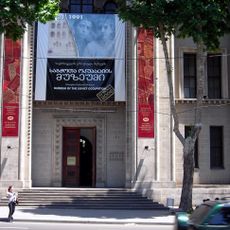
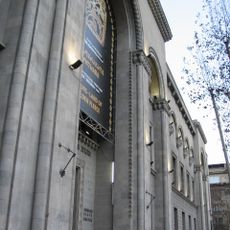
The Georgian Parliament Building is a large administrative structure on Rustaveli Avenue composed of two connected sections with a central courtyard. The design is dominated by monumental arched forms, while its outer walls are finished in cut tufa rock and granite.
The complex was built as the House of Government of the Georgian SSR on the site of the demolished 19th-century Alexander Nevsky Cathedral and its churchyard, where Georgian cadets killed during the 1921 Bolshevik invasion were buried. The upper building was designed by Viktor Kokorin and Giorgi Lezhava and built from 1933 to 1938; the lower building along Rustaveli Avenue followed from 1946 to 1953 with input from Vladimer Nasaridze. Severely damaged during the December 1991–January 1992 coup, it was restored and served as the seat of Parliament from 1997 to 2012, then again fully from January 2019 after the 2017 constitutional amendment took effect.
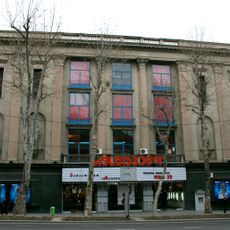
The building blends Georgian architectural elements such as arched forms with Soviet administrative design from the Stalin era. The exterior in tufa and granite shows this mixture clearly when viewing the structure from the street.
The complex stands at 8 Rustaveli Avenue, near the foothills of Mount Mtatsminda. Its two blocks are joined by a courtyard with staircases and fountains, and the avenue facade is dominated by a monumental arcade with massive eaves and an arch pediment. The Parliament has sat here again since January 2019.
The cadet graves were in the churchyard of the demolished Alexander Nevsky Cathedral, on the site the complex later occupied; they commemorated Georgians killed during the Bolshevik invasion of 1921. The cathedral itself was pulled down to clear the plot for the House of Government of the Georgian SSR.
The community of curious travelers
AroundUs brings together thousands of curated places, local tips, and hidden gems, enriched daily by 93,186 contributors worldwide.