Bust of Pushkin in Tbilisi, Bronze monument at Freedom Square, Tbilisi, Georgia
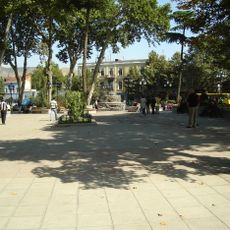
The Bust of Pushkin in Tbilisi is a bronze bust of the poet set on a pedestal of red and grey stone, standing in Pushkin Square near Freedom Square. Sculptor Felix Khodorovich made the bust in Tbilisi between 1 June and 19 October 1891, and the monument was unveiled on 25 May 1892. The bust was cast in dark Venetian bronze at the Karl Werfel factory in St. Petersburg, while the pedestal was worked in Tbilisi from Kutaisi red and grey stone blocks in Vincenzo Palazzi's workshop.
In 1890 the Tiflis police chief L. A. Rossinsky petitioned the city council to place a Pushkin bust in the garden on Yerevan Square, and 2,281 rubles 05 kopecks were raised by subscription. The free sculptor Felix Khodorovich made the bust in Tbilisi between 1 June and 19 October 1891 for 2,236 rubles. It was unveiled on 25 May 1892, the 55th anniversary of the poet's death.
Pushkin spent two weeks in Tbilisi in 1829, from 26 May to 10 June, and the bust was placed in the garden later named after him. The pedestal was meant to carry two inscriptions, but they were removed, leaving only initials A. S. before the surname.
The monument stands permanently in an open square and is freely accessible at any time of day or night. You can view the sculpture in all seasons and during any weather conditions.
The pedestal was cut in Tbilisi by Vincenzo Palazzi's workshop from red and grey stone, which the Russian article calls Algeti stone and the Georgian article calls Kutaisi stone. The bust itself was cast in dark Venetian bronze at Karl Werfel's plant in St. Petersburg.
The community of curious travelers
AroundUs brings together thousands of curated places, local tips, and hidden gems, enriched daily by 94,370 contributors worldwide.