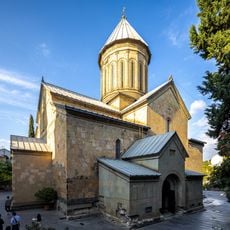
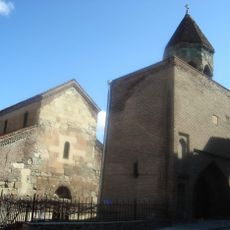
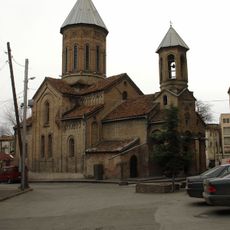
Church of the Holy Seal, Armenian church in Tbilisi, Georgia.
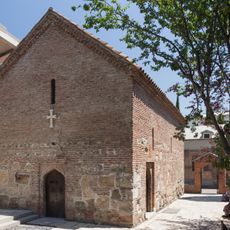
The Church of the Holy Seal is an Armenian church building in Tbilisi with a rectangular floor plan, brick construction, and a double-pitched roof sheltering a single nave ending in a semicircular apse. The interior space reflects the geometric simplicity characteristic of Armenian religious architecture.
The present church was built between 1703 and 1711 and reconstructed in 1780. It was badly damaged during Aga Mohammad Khan's invasion of 1795. Its early history and ownership are disputed between the Armenian and Georgian churches. In Soviet times it served storage purposes, and after fires in 2002 and 2012 and a flood it stands ruined, with worship never resumed.
The church's Armenian name, Surb Nshan, means Holy Seal. Its ownership is disputed between the Armenian and Georgian churches. Worship has not resumed, and the building has stood ruinous since fires in 2002 and 2012 and a flood. Two burials are recorded there: Avetik Piroyan (1858) and Barseg Meyvininyants (1894).
The church stands on Serebryanaya (Silver) Street in the Old Town historic district, reachable on foot from the Avlabari metro area. It is a ruin after the fires of 2002 and 2012 and a flood, with no services held, so it is viewed from outside. New construction is planned immediately next to the building.
The church stands on Serebryanaya (Silver) Street in the Old Town, and its ownership is still disputed between the Armenian and Georgian churches. Two burials are recorded inside: Avetik Piroyan (1858) and Barseg Meyvinyants (1894). Services have never resumed; after fires in 2002 and 2012 and a flood, the building is a ruin, and new construction is planned next to it.
The community of curious travelers
AroundUs brings together thousands of curated places, local tips, and hidden gems, enriched daily by 94,420 contributors worldwide.