Árpád Bridge, Girder bridge in Budapest, Hungary
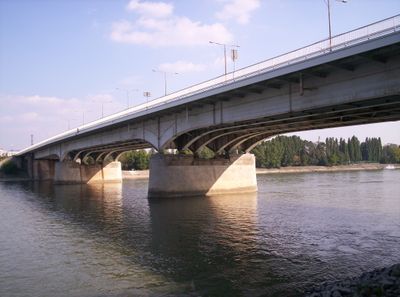
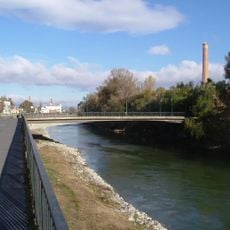
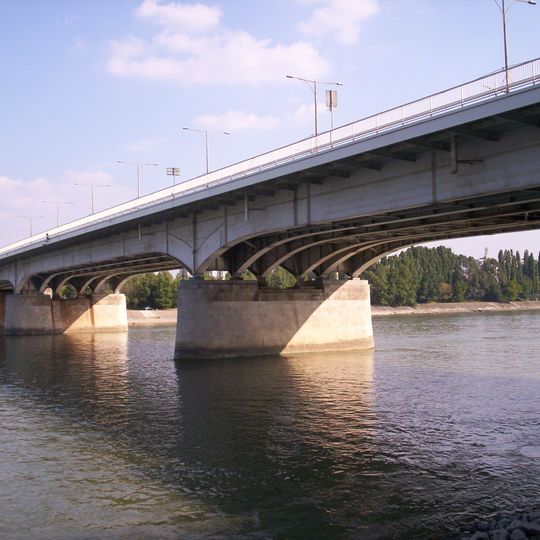
The Árpád Bridge is a steel girder bridge over the Danube linking Óbuda in Buda with Pest, 928 m long without its approach sections and 35.3 m wide. It consists of three parallel, connected structures: the original 1950 deck carries the tram tracks in the middle, while two decks added in the 1980s flank it for road traffic, with 5 cm gaps between them.
Construction began in 1939 based on János Kossalka's design, but World War II interrupted the work, and it finally opened on November 7, 1950. It was originally called Stalin Bridge before receiving its current name.
The bridge carries the name of Grand Prince Árpád, chosen in 1929 when the design tender was announced; under the communist regime it opened in 1950 as Stalin Bridge, and the Árpád name was restored in 1956. The Pest-side metro station kept the name Árpád híd until 31 January 2020.
The bridge carries more than 100,000 vehicles a day, making it Budapest's busiest. Trams run on the central span, while cars use the two outer structures; the northern walkway has a raised-railing cycle path. Margaret Island is reached by a branch roughly mid-span, and the Pest end connects to the Göncz Árpád városközpont metro station.
The 1980–1984 widening did not replace the bridge but added a new structure on each side, so the Árpád Bridge is really three parallel bridges joined together. Standing underneath, the gaps of 5 cm between the three structures are visible. The steel elements were lifted into place between 1981 and 1983 by the Clark Ádám floating crane, built in 1980 for the job.
The community of curious travelers
AroundUs brings together thousands of curated places, local tips, and hidden gems, enriched daily by 92,776 contributors worldwide.