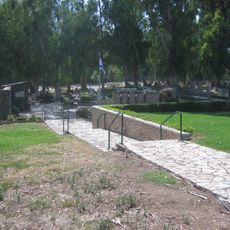
Degania Dam, Water management dam in northern Israel
The Degania Dam is a water control structure where the Jordan River exits the Sea of Galilee in northern Israel. Two floodgates in its design allow operators to manage the volume of water flowing downstream into the river.
The dam was built in the early 1930s by Pinhas Rutenberg as part of the Naharayim hydroelectric plant, to control how much Sea of Galilee water fed the turbines. To allow work in dry ground, a diversion channel was dug north of the riverbed, and the Jordan's outlet was deepened from about -211 m to -214.5 m to enlarge the lake's storage. After the plant closed following the 1948 war and the National Water Carrier opened in 1964, the dam's role became limiting the lake's outflow to the Jordan.
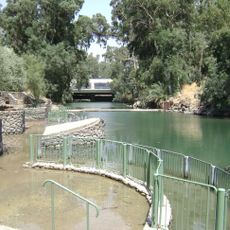
The dam sits just upstream of Yardenit, the baptism site on the Jordan River where pilgrims have immersed themselves for decades. Since 2013, a steady release of Sea of Galilee water through a small opening at Degania has fed the lower Jordan, sustaining the flow at Yardenit and the downstream agriculture. The dam itself is operated by Mekorot, and its gates carry screens that keep the lake's fish from escaping into the river.
The dam lies just below the Sea of Galilee near Degania Alef and Yardenit, about 3 km north of Alumot Dam, where the fresh-water stretch of the lower Jordan ends. The gates are opened only when the lake nears the upper red line, so a visit rarely coincides with a release; the 1995 opening lasted from 9 to 19 February. Mekorot operates the site.
The dam has two floodgates rated to release 800 m3/s, but the flow when opened is usually 150–170 m3/s, enough to lower the Sea of Galilee by up to 8 cm in a day. Inflows during heavy rain can reach about 400 m3/s, so operators open the gates only partially to avoid damage in the Jordan Valley.
The community of curious travelers
AroundUs brings together thousands of curated places, local tips, and hidden gems, enriched daily by 92,638 contributors worldwide.