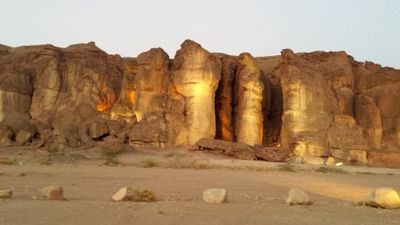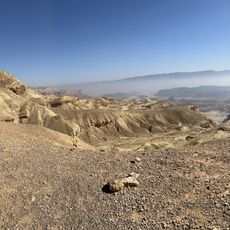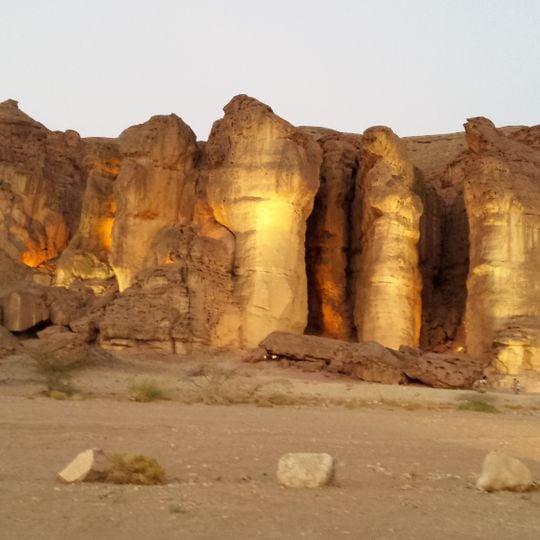
Solomon's Pillars, Natural rock formation in Timna Valley, Israel.
Solomon's Pillars is a cluster of tall sandstone pillars in Timna Valley, north of Eilat, rising about 40 metres. Wind and water eroded the red sandstone along fracture lines, separating rounded, light brown and tan columns with dark vertical crevices; loose boulders and rubble of the same stone lie at their base on flat, sandy desert ground.
Egyptian mining expeditions reached Timna in the 14th century BCE and extracted copper until the 12th century BCE, when the crews were withdrawn and the mines passed to the Midianites, later perhaps shared with Edom. At the foot of the pillars they built a temple to Hathor, goddess of mining, founded under Seti I (1294–1279 BCE) and restored under Ramesses II (1279–1213 BCE), remaining in use until Ramesses V (1147–1143 BCE). Excavations there yielded sandstone sphinx and female heads, and a rock stela of Ramesses III.
The name was given in the 1930s–40s by biblical archaeologist Nelson Gluck, who identified the Timna Valley mines as King Solomon's copper mines. At the foot of the pillars, Egyptians who mined copper in the 14th–12th centuries BCE built a temple to Hathor, goddess of mining; after they left, the Midianites used it, roofing it with tent cloth and placing a copper snake in its inner sanctum.
Visiting early in the morning helps avoid the intense midday heat and provides the best visibility of the formations. Bring plenty of water since the area offers no shade and direct sun exposure is constant throughout the day.
Over millennia, heavy rains and wind forces have carved natural staircases and channels into the rock walls, allowing visitors to climb partway up these erosional features. These naturally formed steps continue to shift as the ongoing erosion process reshapes the rock.
The community of curious travelers
AroundUs brings together thousands of curated places, local tips, and hidden gems, enriched daily by 93,649 contributors worldwide.