Cabo de Rama, Fortified military complex in Canacona, India
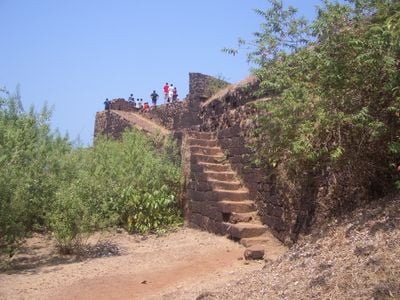
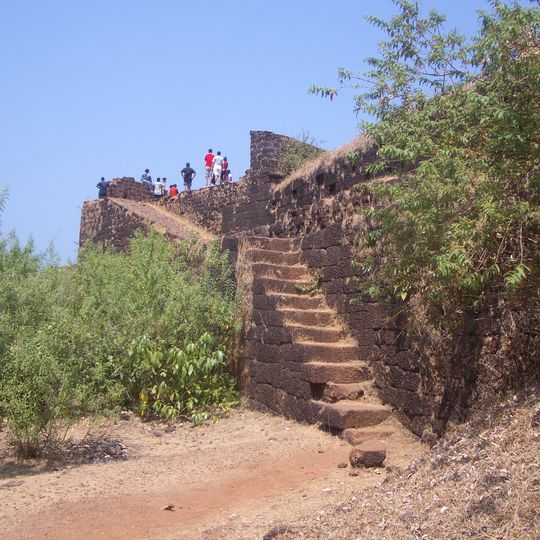
Cabo de Rama is a hillfort in Khola village, Canacona, Goa, built from dark, rough-hewn stone blocks in reds, browns and blacks. A straight flight of stone steps rises on the right through squared masonry to a flat upper level, with low wall sections and a short parapet running left. On the left the wall drops as a steep sloping face above an earth bank. The Portuguese-era remains include walls, moats, ramparts, turrets, a chapel and cannons.
The Raja of Soonda surrendered his territory to the Portuguese in the 1760s in return for protection against Hyder Ali of Mysore, giving them Cabo de Rama. Before that, the fort had regularly switched hands between Hindu and Muslim monarchs. The Portuguese equipped it with 21 guns, military barracks, a commander's quarter and a chapel; it later served as a government prison until 1955.
Inside the fort stands the Capela de Santo António, a small chapel that still receives devotees. The fort's original design was a Muslim-style fortification with fifteen bastions and a landward moat, and the chapel is the one building in the complex still in religious use.
The fort stands in Khola village, Canacona taluk, at the end of the road to the headland; the entrance is a 20th-century building, probably raised by the Portuguese military before 1961. The site is in a precarious state of conservation, so walk carefully on the rough stone steps and along the low parapets. The chapel of Santo António inside still receives devotees.
The fort has two drinking-water springs of different temperatures that still flow, plus a small lake. The entrance building dates from the 20th century, probably raised by Portuguese soldiers before 1961, and a small cross in the car park commemorates a deceased Goan nurse in Portuguese.
The community of curious travelers
AroundUs brings together thousands of curated places, local tips, and hidden gems, enriched daily by 93,493 contributors worldwide.