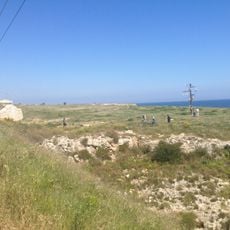
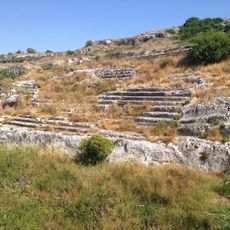
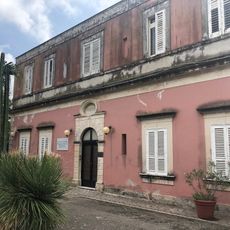
Porta Scea, City gate in Syracuse, Italy.
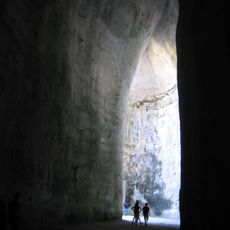
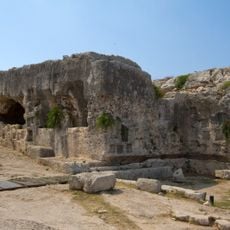
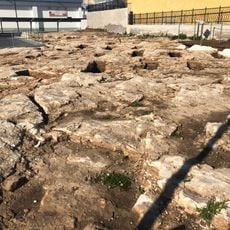
Porta Scea is a Greek-era gate cut into the rock at the northern entrance of Syracuse, near the Scala Greca road axis. The passage is deeply excavated and bends to overcome the height difference of the ledge, a curve that probably limited the use of battering rams. Deep cart-wheel ruts and small holes for cattle or horses to keep their footing are visible along the access.
Porta Scea was part of the Dionysian Walls, the defensive circuit built for Syracuse under the tyrant Dionysius I in the early 4th century BC. The gate opened northward toward the road to Catania, near where the Exapilon gate probably stood. The passage was cut deep into the rock and bends as it climbs the ledge, a curve that would have hampered battering rams.
The gate's name, Scea, refers to the left-hand side, from the Greek skaios, because it opened toward the road running north to Catania. The passage was cut into the rock and bends as it climbs, a curve that slowed charging rams. Deep ruts of cart wheels and small holes for the hooves of oxen and horses are still visible along the ramp.
Porta Scea lies a few metres from Syracuse's northern entrance on the Scala Greca road axis, not in Ortygia. The passage is cut deep into the rock and bends to overcome the drop of the ledge, so wear firm shoes for the uneven, sloping ground. Look for the deep cart-wheel ruts and the small holes cut to keep oxen and horses from slipping.
The passage is cut deep into the rock and bends as it climbs the slope, a curve that probably limited the use of battering rams. Along the roadway, deep cart-wheel ruts and small holes cut in the centre of the track are still visible; the holes kept oxen or horses from slipping as they hauled loads up the incline.
The community of curious travelers
AroundUs brings together thousands of curated places, local tips, and hidden gems, enriched daily by 93,358 contributors worldwide.