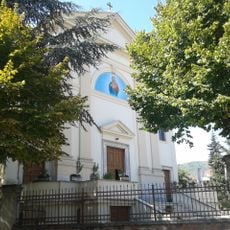
Palazzo Torlonia, Palace in Avezzano, Italy.
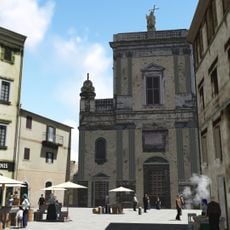
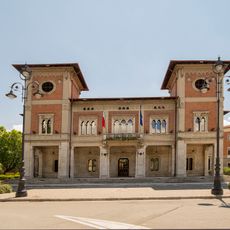
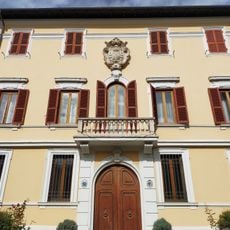
Palazzo Torlonia is a two-story palace rebuilt in the 1920s after the 1915 Marsica earthquake, which destroyed the 1870s original with its third floor, bell tower and clock. Its facade faces Piazza Torlonia, and the first floor holds the Avezzano section of the State Archive and the Ugo Maria Palanza Marsican Studies Centre.
The palace was built between 1870 and 1875 but suffered severe damage during the 1915 earthquake. It was subsequently reconstructed following new seismic safety standards and reopened in 1925.
The 1932 murals on the first floor were painted by Vincenzo Alicandri in the Prince's room and Francesco Antonio Bianchi in the atrium, later joined by work from Pietro Cascella. They depict the sacrifice of the pioneers who drained Lake Fucino. The painted ceramic floors come from Vietri sul Mare, and Carlo Torlonia commissioned Liberty-style majolica designs from Richard-Ginori, Cantagalli and Villeroy & Boch.
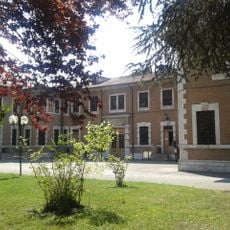
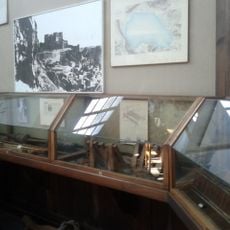
The State Archive section and the "Ugo Maria Palanza" Marsican Studies Centre occupy the first floor of the historic palace, while the adjacent modern four-story block, rebuilt between 1971 and 1976, holds regional technical offices. Access is from Piazza Torlonia, beside the municipal villa gardens.
The sculpted coat of arms of the Principato del Fucino, with a phoenix on a pyre above the crown, was placed on the pediment above the balcony around 1927; it was lost in 1944, when retreating German troops looted tapestries and furnishings, and replaced by an eagle on a helmeted crest.
The community of curious travelers
AroundUs brings together thousands of curated places, local tips, and hidden gems, enriched daily by 94,458 contributors worldwide.