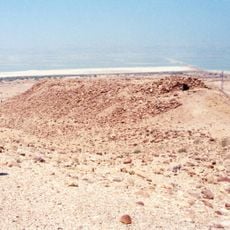
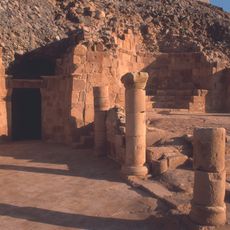
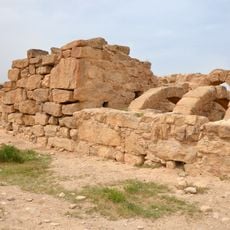
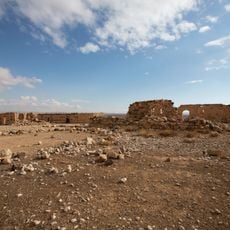
Qasr Abu Rukba, Roman watchtower in Karak Governorate, Jordan.
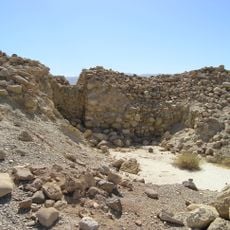
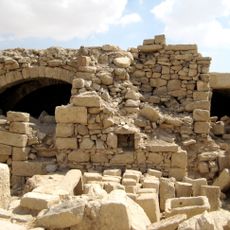
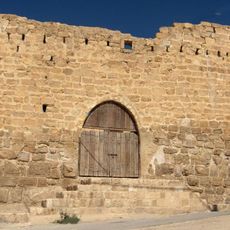
Qasr Abu Rukba is a late antique burgus of the Roman and later Byzantine frontier troops, built on a slope of the Jebel Abu Rukba in the desert zone of Karak Governorate, Jordan. The well-preserved rectangular tower measures about 10.90 by 10.25 metres, with walls 1.30 metres thick of mortared, coursed ashlar and a preserved height of up to 9.70 metres at the west corner. Its 1.35-metre-wide ground-floor entrance lies in the northwest wall, and two slit windows were set in the first floor of the southwest and southeast walls.
Qasr Abu Rukba was probably built only in late antiquity as a burgus of the Roman, later Byzantine, frontier troops. Alfred von Domaszewski and Rudolf Ernst Brünnow first surveyed it in 1898, drawing its first elevation and plan and photographing it. Nelson Glueck visited on 21 May 1933 but published no new research, referring to their descriptions in 1934. Samuel Thomas Parker re-surveyed it during his Limes Arabicus Project (1980–1989); Shelagh Gregory rejected his dating in 1997.
The name Qasr Abu Rukba is a modern designation; the site was also known as Abu Rukbe. The tower's masonry differs from Nabataean dry-stone towers: its dressed blocks were laid in mortar and carried plaster. In 1898 Alfred von Domaszewski and Rudolf Ernst Brünnow made the first measured plan and photographs of the structure.
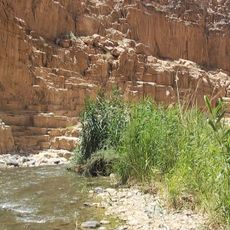
The burgus stands on a plateau on the southeastern-northwestern edge of the Jebel Abu Rukba slope, reached only by rough desert tracks, so a local guide or knowledge of the terrain is needed. The ground drops almost 60 metres over 590 metres northeast towards the Wadi Abu Rukba. The nearby ruin of Qasr at-Tamra, 1.35 kilometres to the southwest, was in sight of the tower.
Shelagh Gregory rejected Parker's dating in 1997, arguing that many such towers are Iron Age or Nabataean in origin and that the Romans usually only reoccupied them. She also found no parallel between Qasr Abu Rukba and Qasr Bshir, since she assumed completely different internal structures for the two buildings.
The community of curious travelers
AroundUs brings together thousands of curated places, local tips, and hidden gems, enriched daily by 94,475 contributors worldwide.