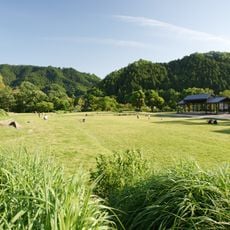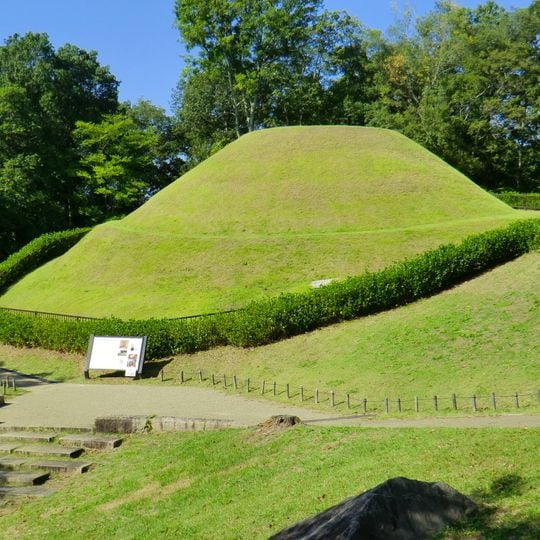
Takamatsuzuka Tomb, Circular burial mound in Asuka, Japan
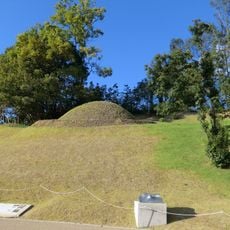
Takamatsuzuka Tomb is a two-tier circular mound in Asuka, Nara Prefecture, with a lower grassy shelf about 23 m across and an upper dome about 18 m wide, rising 5 m. Its stone chamber, built of cut tuff slabs, measures roughly 2.65 m north to south, 1.03 m east to west and 1.13 m high inside, and its walls and ceiling carry painted plaster murals.
Built between 694 and 710, the tomb was long dismissed as unimportant until villagers digging a ginger-storage hole in October 1970 struck old cut stones. Excavation by the Kashihara Archaeological Institute with Kansai and Ryukoku universities began on 1 March 1972, and the painted chamber was opened on 21 March. It was made a Special Historic Site in 1973 and the murals a National Treasure in 1974.
The west-wall women are called the Asuka Beauties; they carry a ruyi sceptre, a round fan and a whisk, items listed for officials at the New Year's morning greeting in the Jogan Ceremony. Men hold couches, polo sticks, parasols, weapons and bags. A 2026 analysis found red lac resin on the Lady in the Pink Garment's skirt, pointing to trade reaching South and Southeast Asia.
The mound itself is open to the public, rebuilt in 2009 in its original two-tier form; a low line of wooden posts and shrubs marks its base. The painted stone chamber was moved to a repair facility in the park in 2007, and its conservation was completed in March 2020. The chamber is only about 2.65 m long, 1.03 m wide and 1.13 m high, so it was never open for visitors to enter.
The west-wall women are called the Asuka Beauties and appeared in school textbooks. Analysis of the red pigment on one figure's skirt identified lac resin, showing that Asuka-period Japan traded with South and Southeast Asia.
The community of curious travelers
AroundUs brings together thousands of curated places, local tips, and hidden gems, enriched daily by 94,057 contributors worldwide.