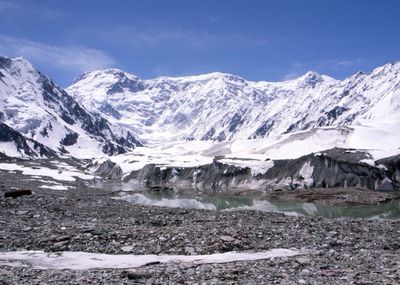
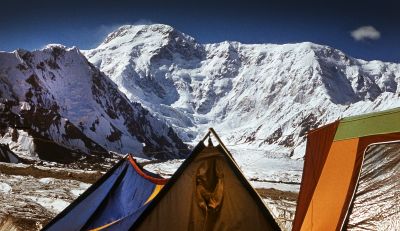
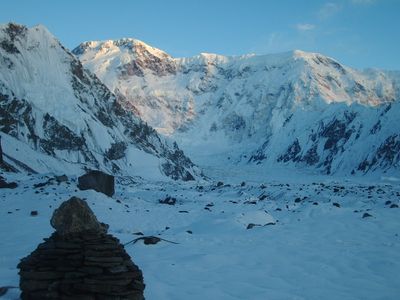
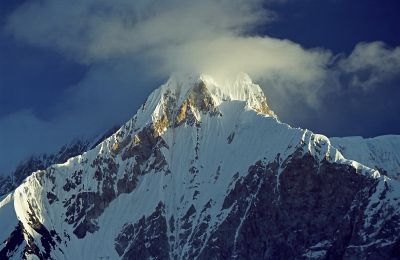
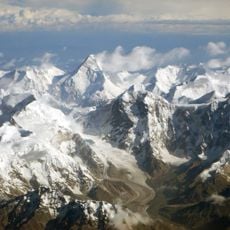
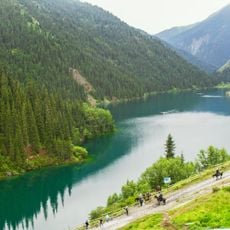
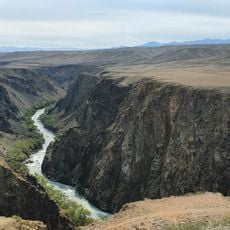
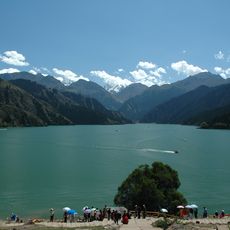
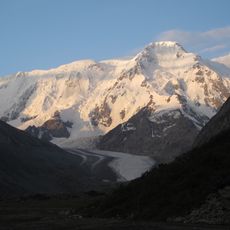
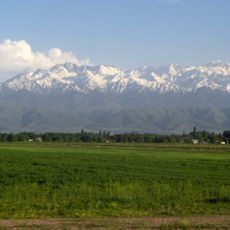
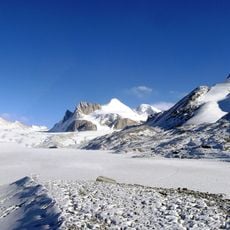
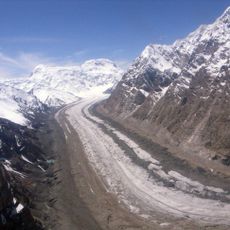
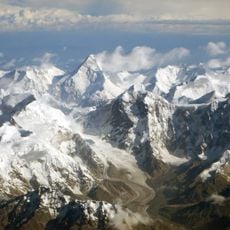
Jengish Chokusu, Mountain summit at Tian Shan range, China and Kyrgyzstan.
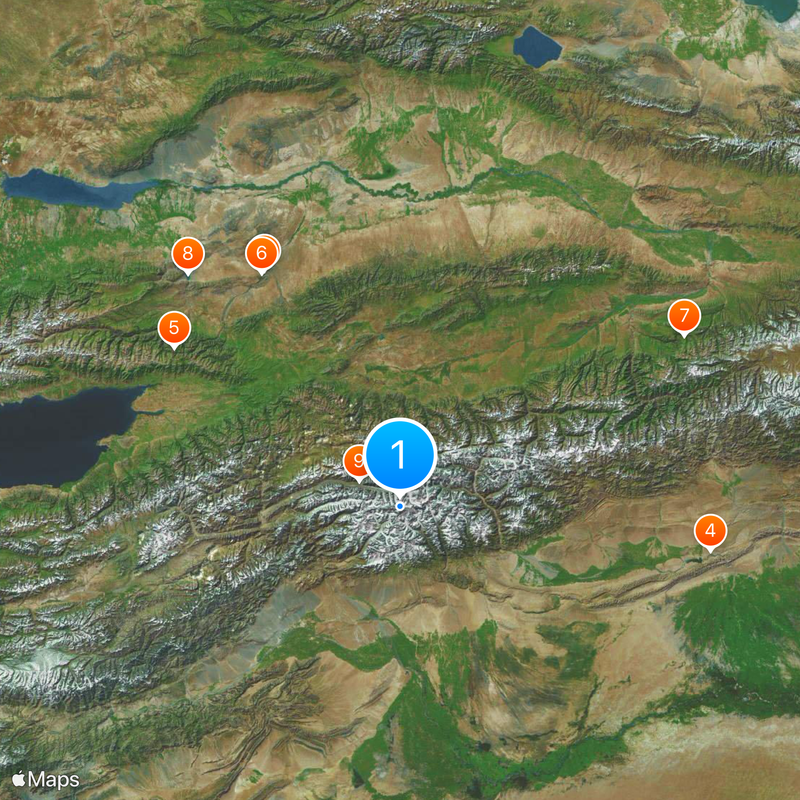
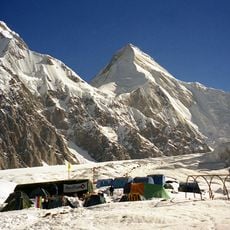
Jengish Chokusu is a massif on the Kyrgyzstan–China border in the Kakshaal Too range, 16 km southwest of Khan Tengri. Its main summit reaches 7,439 m, the highest point of the Tian Shan. The massif runs along a ridge about 2 km long, with several summits, and only the main summit exceeds 7,000 m. Its upper slopes are snow and ice broken by dark rock bands, and the Zvozdochka glacier below is coloured red by rock debris from the mountain.
A 1938 Soviet expedition led by A. A. Letavet reached 6,930 m on 19 September and named the peak for the 20th anniversary of the Komsomol. A 1943 military survey under P. N. Rapasov established the true height of 7,439 m, and the peak was renamed Pik Pobedy in 1946 for the Soviet victory in World War II. In August 1955 a blizzard killed 11 of 12 climbers; the sole survivor, Ural Usenov, joined Vitaly Abalakov's party for the first verified ascent on 30 August 1956.
The Kyrgyz name Jengish Chokusu and the Russian Pik Pobedy both mean "Victory Peak"; the Russian name was given in 1946 for the Soviet victory in World War II. On the Chinese side the peak is Tomur Feng, from the Uyghur Tömür, "iron." The Zvozdochka glacier, the usual approach, is coloured red by rock washed down from the massif.
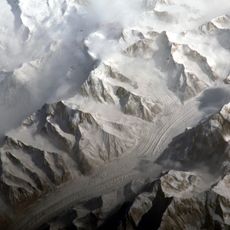
The usual approach is from the Zvozdochka glacier, where base camp sits at 4,200 metres. The massif's ridge runs about 2 kilometres, and stable weather is rare and brief. The north side is drained by the 60.5-kilometre South Engilchek Glacier, the sixth longest outside the polar regions.
The mountain is the northernmost 7,000-meter peak on Earth and hosts the South Engilchek Glacier, one of the region's longest glaciers. Few other locations worldwide share this extreme geographic distinction.
The community of curious travelers
AroundUs brings together thousands of curated places, local tips, and hidden gems, enriched daily by 94,043 contributors worldwide.