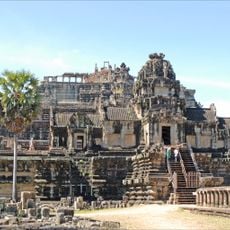
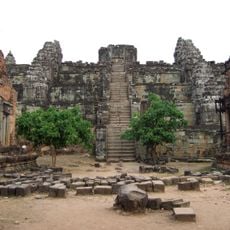
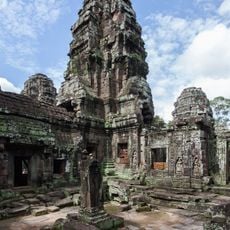
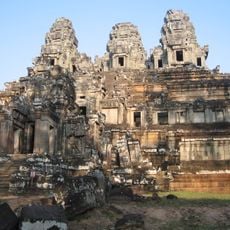
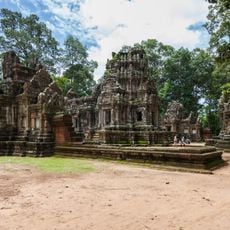
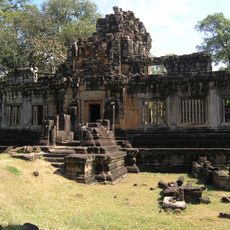
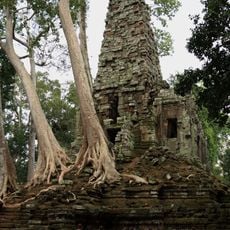
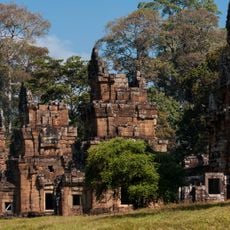
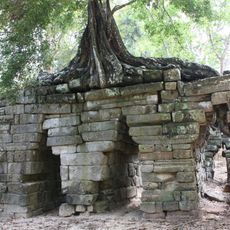
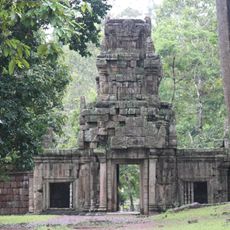
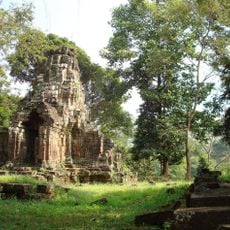
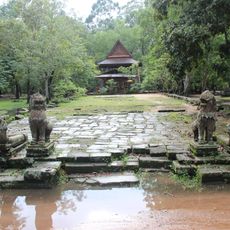
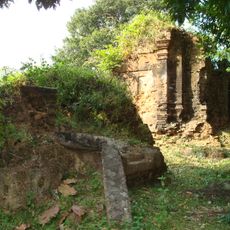
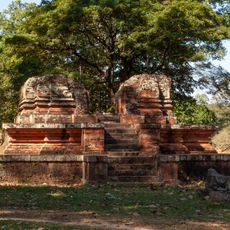
Preah Pithu, Temple complex in Angkor, Cambodia.
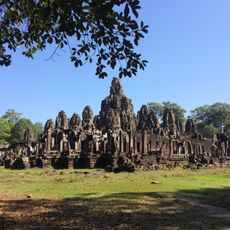
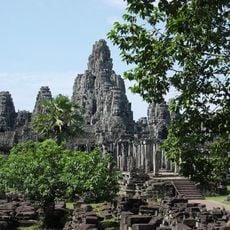
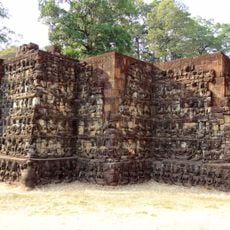
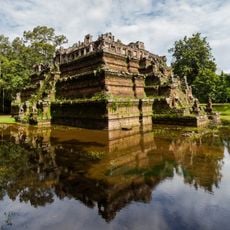
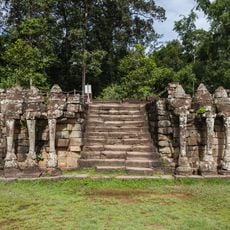
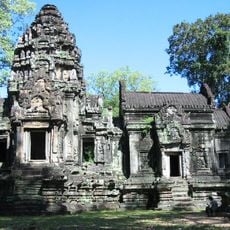
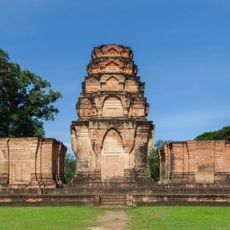
Preah Pithu is a group of five ruined temples in Angkor Thom, north-east of the Bayon and in front of Tep Pranam. They are identified by the letters T, U, V, W and X, and were not built as a single group: T and U share a west-east axis and a single moat, while X, a Buddhist temple, stands unfinished on a 4-metre laterite terrace about 100 metres east of U. The temples have sandstone enclosure walls, cruciform terraces with naga balustrades, and carvings in the Bayon and Angkor Wat styles.
Most of the five temples were built in the first half of the 12th century under Suryavarman II, in the Angkor Wat style; temple X, a Buddhist sanctuary, was probably added in the 14th century. The École française d'Extrême-Orient cleared vegetation in 1908 under Jean Commaille and from 1918 to 1920 under Henri Marchal. Angkor, including Preah Pithu, became a UNESCO World Heritage Site in 1992.
The temples are identified by the letters T, U, V, W and X. Temple X, the unfinished Buddhist sanctuary, has a double row of sculpted Buddhas on the walls of its chamber and Buddhist motifs on the lintels. The Hindu temples carry devatas, dvarapalas and lintels showing the Churning of the Sea of Milk and the Trimurti, with Shiva dancing on a kala head between Vishnu and Brahma.
The complex is easiest to visit in early morning hours when light is good for exploring and fewer visitors are present. Access is from the eastern side of the main road, and sturdy footwear matters on the uneven paths between the temples.
The unfinished Buddhist temple X holds a double row of sculpted Buddhas on its sanctuary walls, and its laterite terrace is bordered by semas marking the sacred area. The most notable reliefs, showing Siddhartha cutting his hair, are no longer in place.
The community of curious travelers
AroundUs brings together thousands of curated places, local tips, and hidden gems, enriched daily by 94,414 contributors worldwide.