Angkor Wat

Log in to your account

AroundUs is a community-driven map of interesting places, built by curious explorers like you. It grows with every review, story, and photo you share.
Connect to save your favorite spots, contribute locations, and create personalized routes.
By continuing, you accept our Terms and Conditions and our Privacy Policy
Add to collection
Map
Suggest a change
Share

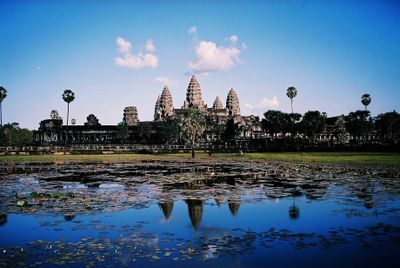
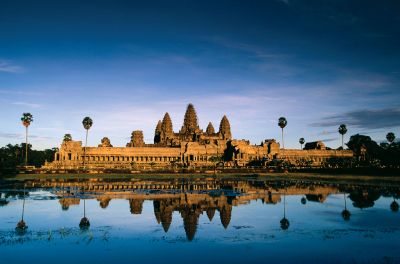
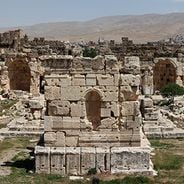
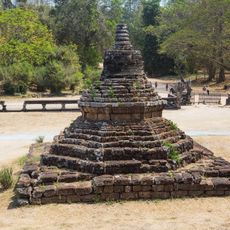
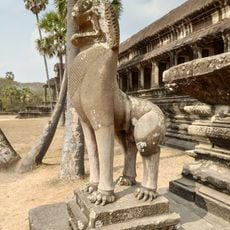
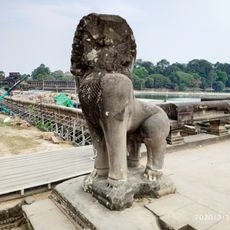
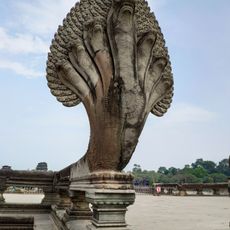
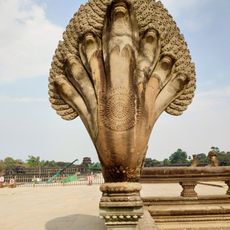
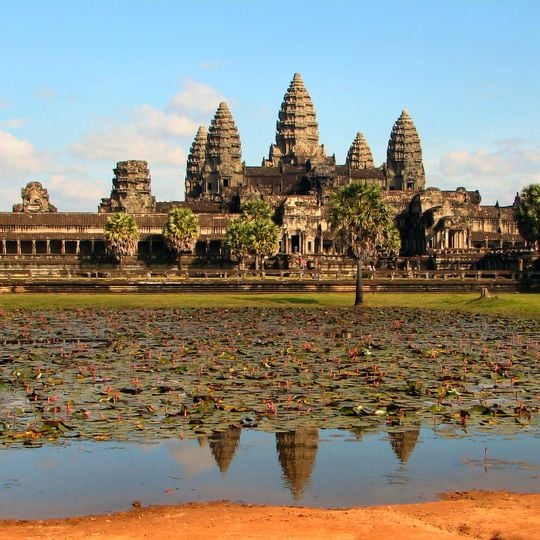
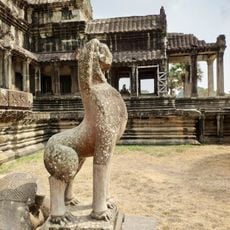
Angkor Wat, Buddhist temple in Siem Reap Province, Cambodia

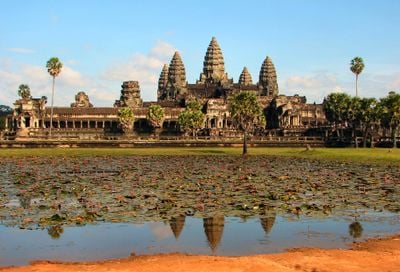
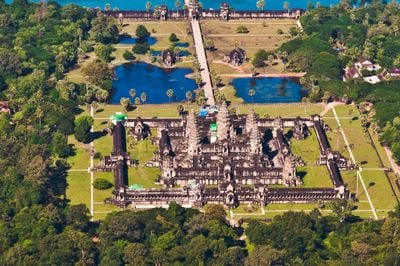
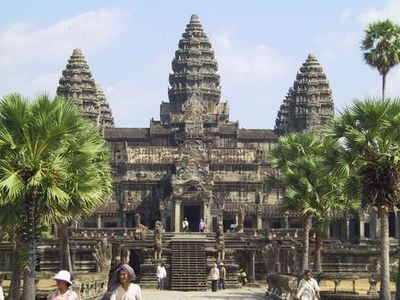
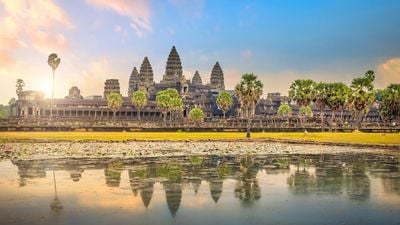
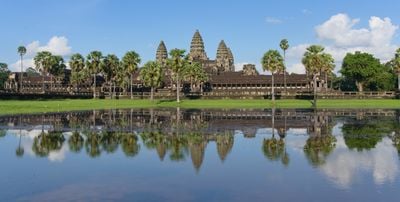
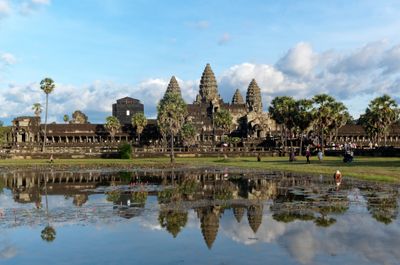
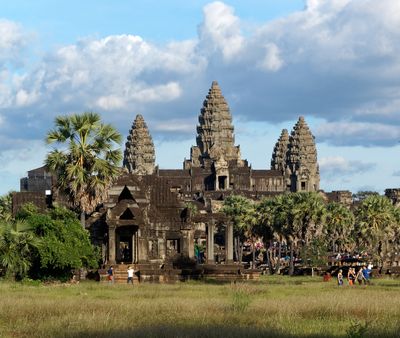
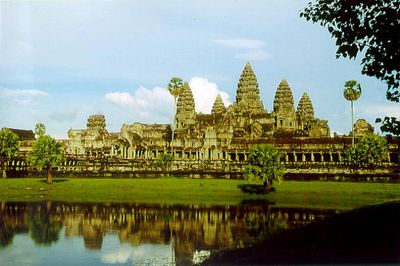
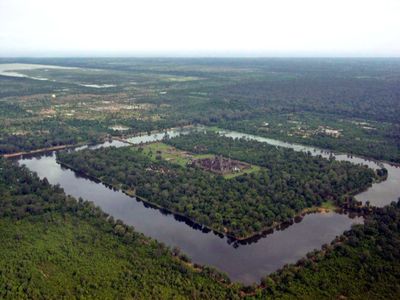
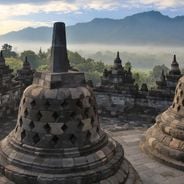
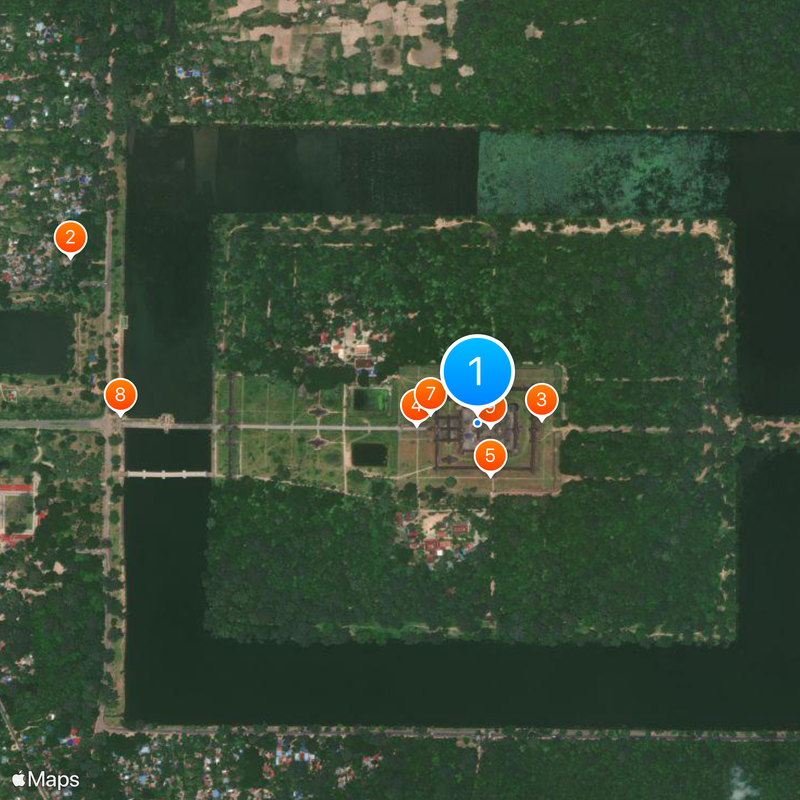
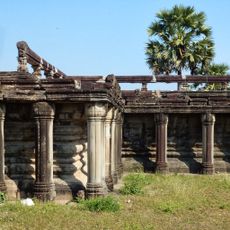
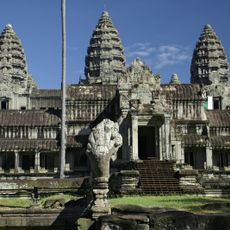
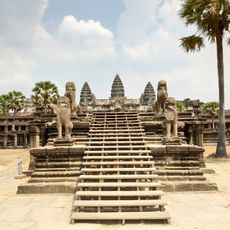
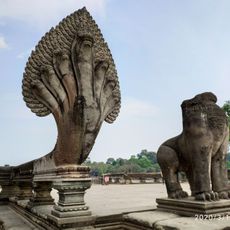
Angkor Wat is a Buddhist temple in Siem Reap Province, Cambodia, built from five stone towers that rise from three rectangular galleries. A moat more than three miles (5 kilometers) long surrounds the compound completely, reflecting the towers at dawn.

King Suryavarman II ordered the temple built around 1122 for the Hindu god Vishnu, and work finished around 1150 during the height of the Khmer Empire. Later centuries saw it transform into a Buddhist monastery without removing the old stone carvings.

Monks in saffron robes arrive each morning to meditate and pray, reminding visitors of the site's ongoing religious significance. Locals often light incense sticks and leave offerings before the Buddha statues placed throughout the ancient galleries.

Visitors should arrive early in the morning to avoid crowds and catch the best light for photography, especially during the rainy season from May to October. Paths between the galleries can be uneven, so comfortable shoes are important.

The temple faces west instead of east, which is unusual and may point to its original role as a funerary monument. Scholars believe this orientation relates to ideas about death in Hindu cosmology.

Location: Siem Reap Province

Inception: 12 century

Founders: Jayavaraman II, Khmer people

Creator: Jayavaraman II, Khmer Empire

Architectural style: Thai architecture, Dravidian architecture

Elevation above the sea: 65 m

Part of: Angkor

Address: Krong Siem Reap, Cambodia

Opening Hours: 5:00-17:30

Phone: +85563765577

Website: https://angkorenterprise.gov.kh/temple/65/angkor-wat

GPS coordinates: 13.41250,103.86667

Latest update: December 2, 2025 21:17

Abandoned places around the world

This collection includes abandoned cities, industrial facilities and historic sites across multiple continents. Empty buildings, decaying streets and left-behind objects tell the stories of people who once lived and worked there. The reasons for abandonment vary: industrial decline led to the closure of factories and mines, natural disasters forced entire communities to relocate, military conflicts made areas uninhabitable, and economic changes caused once-thriving settlements to empty. Today the structures stand silent while vegetation slowly reclaims the buildings and streets. Visitors find traces of past eras: abandoned schools with textbooks still on desks, decommissioned power plants with rusting machinery, deserted villages with crumbling houses. These places document social, economic and political developments and offer insights into different chapters of industrial history, urban development and the effects of human decisions on inhabited spaces.

Military buildings and fortresses worldwide

Military buildings from different countries demonstrate the evolution of defense structures and command centers across centuries. This collection includes medieval castles, early modern fortifications, barracks, command posts, and contemporary military installations. Each structure documents the military strategies, technological advances, and historical events of its era. The sites range from European fortress systems such as Vauban fortifications in France to Asian defensive walls and American military bases from various periods. Many of these structures played critical roles in wars and conflicts and are now accessible as monuments or museums. They provide insights into military architecture, engineering practices, and the strategic importance of their locations.

Archaeological sites across the world

These archaeological sites document the development of human civilizations across thousands of years. They range from the earliest known temple structures like Göbekli Tepe in Turkey, dated to around 9500 BCE, to the preserved remains of Pompeii, frozen in time by a volcanic eruption in 79 CE. Each location offers insights into the technical abilities, religious beliefs, and social structures of past cultures. The collection includes monuments such as the Great Pyramid of Giza in Egypt, standing for over 4,500 years, and Machu Picchu in the Peruvian Andes, a 15th-century Inca stronghold at 7,970 feet (2,430 meters). In China, the Terracotta Army guards the tomb of the first emperor with thousands of life-size soldiers, while Angkor Wat in Cambodia represents the largest religious complex in the world. European sites like Stonehenge in England and the Acropolis in Athens demonstrate prehistoric engineering and classical Greek architecture. These places connect visitors to the societies that built them centuries or millennia ago.

Famous movie filming locations around the world

Cinema transforms real places into legendary sets, and some filming locations have become as famous as the movies themselves. From Hobbiton in New Zealand, with its round-door houses built for Tolkien adaptations, to the Nabataean temple of Al Khazneh in Jordan, memorable from Indiana Jones and the Last Crusade, these sites showcase the intersection of fiction and reality. Film enthusiasts can walk beneath the hundred-year-old beech trees of The Dark Hedges in Northern Ireland, a scene from Game of Thrones, seek out Platform 9 ¾ at King's Cross Station in London, or explore the Tunisian landscapes that brought Tatooine in Star Wars to life. Other destinations include Alcatraz prison in San Francisco, the deserted island of Monuriki in Fiji, where Cast Away was filmed, or the streets of Salzburg that hosted The Sound of Music. These locations offer visitors the chance to relive iconic scenes and understand how filmmakers utilized authentic sites to craft unforgettable cinematic worlds.

Stairs: historic, architectural, monumental

Stairs serve not only to overcome elevation changes but often rank among the notable structures of their cities. The Spanish Steps in Rome with its 135 steps has connected two districts since 1725 and became a meeting point for locals and visitors. In Montmartre, 222 steps lead to the Basilica of Sacré-Cœur, while Jacob's Ladder on Saint Helena with 699 steps forms one of the longest straight stairways in the world. The selection includes various construction types: spiral staircases in medieval towers, rock-carved ascents to temples and fortresses, and modern outdoor stairs made of concrete and steel. Some stairs were built for practical reasons like the steps to Table Mountain in Cape Town, others as part of religious sites like the stairs to the Golden Rock in Myanmar. Each staircase tells the story of the engineering skills of its era and the people who use it daily.

Ancient stone monuments: sacred sites, temples, and structures dating back thousands of years

This collection encompasses ancient stone monuments and sacred sites from across the globe, ranging from the Easter Island Moai to the Great Wall of China. The structures represent millennia of human engineering and include religious temples, fortifications, burial sites, and astronomical installations. Many of these locations retain cultural significance for local communities today. Examples include prehistoric sites such as Göbekli Tepe in Turkey and Skara Brae in the Orkney Islands, alongside monumental constructions like the Parthenon in Athens, Angkor Wat in Cambodia, and the Pyramids of Giza in Egypt. The collection also features lesser known treasures including the Megalithic Temples of Malta, Nan Madol in Micronesia, and Great Zimbabwe. These sites provide insight into ancient cultures, religious practices, and architectural achievements that continue to draw visitors from around the world.

Ancient temples and religious sites worldwide

Major temples worldwide display architectural and cultural achievements of ancient civilizations. From temples in Cambodia to pyramids in Mexico, these structures document religious practices, construction methods and social structures of their time. The complexes in Asia, Europe and America present different building styles, ornaments and ceremonial spaces.

The 7 new wonders of the world: in map and photo

In 2007, the New Seven Wonders Foundation, led by Swiss businessman Bernard Weber in cooperation with the marketing company Deureka, organized a global vote, the results of which were announced on July 7 in Lisbon. This project, which was especially successful in India and China, enabled the designation of seven monuments representing different civilizations and eras, from antiquity to the 20th century. UNESCO stated in a release that it was not involved in this event, contrary to what many voters believed. The final selection includes sites across all continents: the Great Wall of China, a fortification system built over several centuries; Petra in Jordan, a Nabataean city from the 4th century BC carved into rose-colored rock; the Colosseum in Rome, a 1st-century amphitheater capable of holding 50,000 spectators; Chichen Itza in Mexico, a Maya site demonstrating the astronomical knowledge of this civilization; Machu Picchu in Peru, an Inca city from the 15th century located at 2,430 meters above sea level; the Taj Mahal in India, a white marble mausoleum built between 1631 and 1643; and the Christ Rédempteur statue in Rio de Janeiro, a 38-meter-tall monument inaugurated in 1931. The Khufu pyramid, the only remaining ancient wonder still standing, was removed from the voting list and designated an honorary wonder. The 21 candidate sites were selected by a commission of architects from five continents, chaired by Federico Mayor, former UNESCO Director-General. The criteria included aesthetics, architectural achievement, and historical significance. Each monument had to be constructed by humans, completed before 2000, and in acceptable preservation condition. This collection lists all monuments and allows users to view their locations and photos via individual records.

Reviews

Visited this place? Tap the stars to rate it and share your experience / photos with the community! Try now! You can cancel it anytime.

« Angkor Wat - Buddhist temple in Siem Reap Province, Cambodia » is provided by Around Us (aroundus.com). Images and texts are derived from Wikimedia project under a Creative Commons license. You are allowed to copy, distribute, and modify copies of this page, under the conditions set by the license, as long as this note is clearly visible.

Discover hidden gems everywhere you go!

From secret cafés to breathtaking viewpoints, skip the crowded tourist spots and find places that match your style. Our app makes it easy with voice search, smart filtering, route optimization, and insider tips from travelers worldwide. Download now for the complete mobile experience.
Around Us App Screenshot

A unique approach to discovering new places

Le Figaro

All the places worth exploring

France Info

A tailor-made excursion in just a few clicks

20 Minutes