Suncheon Bay, Protected wetland and UNESCO World Heritage Site in South Jeolla, South Korea.
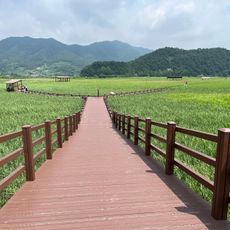
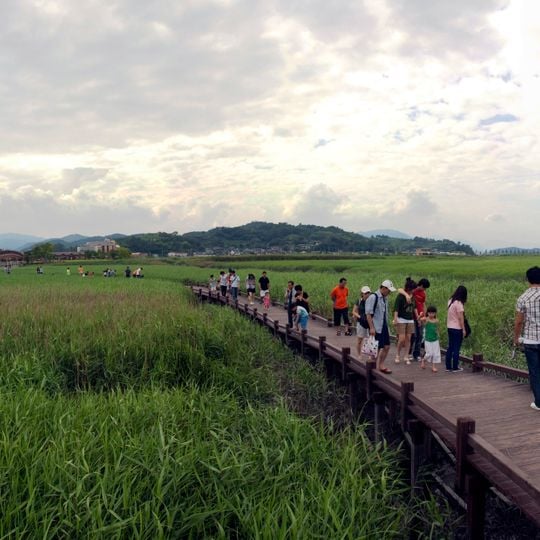
Suncheon Bay is a semi-enclosed inlet on South Korea's south coast where the Dongcheon, Isacheon and Haeryongcheon rivers meet the sea. Its 22.6 km² of mudflat and 5.4 km² of reed beds, the largest reed stand in the country, are cut by winding channels; a raised wooden boardwalk with low rails crosses the reeds, and at low tide pale mud banks and shallow water channels are exposed.
Records from the Three Kingdoms period already describe the Byeollyang and Haeryong areas as tidal coast. During the Joseon Dynasty a large granary storing grain for the king stood in the Hongdu area, now southern Suncheon. Typhoon Sarah struck in 1962, causing floods and redirecting the Isacheon and Dongcheon into today's river mouth.
The S-shaped waterway of Suncheon Bay was chosen by Korean photographers as one of the country's ten best sunset views. From the observation deck, the sunset and flocks of wintering hooded cranes taking flight draw visitors; in 2006 the Korea Tourism Organization named it a top landscape-viewing site. Since 1996, when 59 hooded cranes were first counted, their wintering numbers rose to 2,502 by 2018.
A wooden boardwalk with low rails crosses the reed beds, and an observation tower gives a view over the S-shaped channels and mudflats. The white-naped cranes arrive around October and stay until late March, so winter mornings suit birdwatching. The reed beds and tidal flats are protected, and visitors stay on the walkways.
More than 230 bird species inhabit the reed areas across different seasons, making it one of the country's largest coastal habitats. This diversity draws visitors who want to spot and photograph rare species.
The community of curious travelers
AroundUs brings together thousands of curated places, local tips, and hidden gems, enriched daily by 93,465 contributors worldwide.