Jinnamgwan, Wooden guest hall (gaeksa) in Yeosu, South Korea
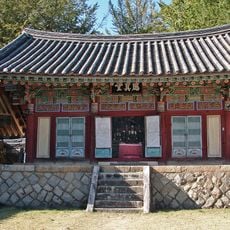
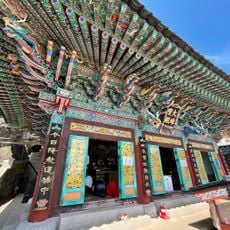
Jinnamgwan is a single-storey wooden guest hall (gaeksa) from the Joseon dynasty, measuring 75 m in length and 14 m in height, with a floor area of 240 pyeong. Its 68 columns, each 2.4 m in circumference, support a tiled roof; the bracket system combines multi-cluster and ikgong techniques, and the side walls have two crossbeams. It is the largest surviving local government building of the Joseon period.
Yi Si-eon, naval commander of Jeolla Province, built Jinnamgwan in 1599 on the site of Jinhaeru, the base burned in 1597 during the Japanese invasions. A fire destroyed it in 1716, and Admiral Yi Je-myeon rebuilt it in 1718. From 1911, under Japanese rule, it housed schools including Yeosu Public Common School.
Jinnamgwan housed the royal tablets (gwolpae) of Joseon kings, and officials bowed to them on the first and fifteenth day of each month. State rejoicing brought congratulatory rites, state mourning brought joint ceremonies by officials and citizens. From 1910 it served as a school, beginning with Yeosu Public Ordinary School.
Jinnamgwan stands in central Yeosu, near the former Jeolla Left Naval Headquarters site. The hall is a single-storey wooden building entered at its front, where the two-storey Mangharu gate was rebuilt in April 1991. Look up at the 68 columns and the dragon-head carvings on the front bay while walking the length of the 15-bay facade.
The 68 columns are each about 14 m tall and 2.4 m in circumference, and the building is Korea's largest single-story wooden structure. Look for the carved lotus buds and dragon heads, and the dancheong paintwork. The hall was used as a school from 1911, starting with Yeosu Public Elementary School.
The community of curious travelers
AroundUs brings together thousands of curated places, local tips, and hidden gems, enriched daily by 93,522 contributors worldwide.