Jusangjeolli, Columnar jointing cliff in Jungmun, South Korea.
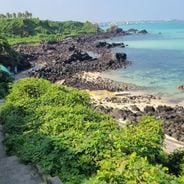
Jusangjeolli is a coastal cliff of columnar basalt at Jungmun on the south coast of Jeju Island, where lava from Hallasan flowed into the sea and cooled into hexagonal and multi-sided stone pillars. The columns form a wall about 20 m tall above the water, and the formation is designated Natural Monument No. 443.
The rock formation developed when lava from Hallasan Mountain flowed into the sea and cooled rapidly, creating these hexagonal columns. This geological process occurred thousands of years ago and reveals Jeju Island's volcanic past.
The name jusangjeolli is the Korean term for columnar jointing, the geological feature that defines the site. The cliff is a popular viewing and fishing spot, and access to the rock formation itself is now controlled.
Visitors can view the rock formation from wooden observation platforms positioned along the coast. Early morning and late afternoon light works best for observing and photographing the columns clearly.
Each of the over 40,000 stone columns has a slightly different size and depth, giving the cliff a natural irregular pattern. These variations resulted from different cooling rates during the solidification process thousands of years ago.
The community of curious travelers
AroundUs brings together thousands of curated places, local tips, and hidden gems, enriched daily by 93,469 contributors worldwide.