Jeju Volcanic Island and Lava Tubes, Volcanic island and cave network in Jeju Province, South Korea.
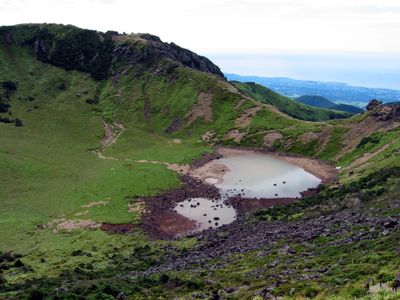
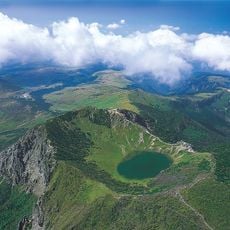
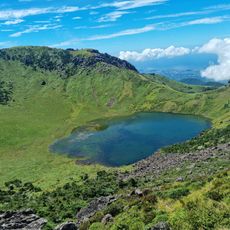
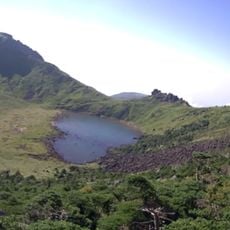
Jeju Volcanic Island and Lava Tubes is a UNESCO World Heritage Site in Jeju Province, South Korea, inscribed in 2007. At its centre stands Hallasan, a dormant shield volcano rising 1,950 m, South Korea's highest peak, with 360 satellite volcanoes around it. The Geomunoreum Lava Tube System, formed by lava from the scoria cone Geomunoreum, comprises five caves: Bengdwigul, Manjanggul, Gimnyeonggul, Yongcheondonggul and Dangcheomuldonggul. Manjanggul's ceiling hangs with dense rows of thin pale stalactites above still blue water, beside layered grey, cream and greenish rock.
The island took shape over millions of years through volcanic eruptions that built up the central shield volcano. This geological process created the landscape we see today and left behind the cave systems now visible underground.
The name Geomunoreum refers to the scoria cone in the island's central-east whose eruptions, hundreds of thousands of years ago, fed the lava that formed the tube system. The system comprises five caves: Bengdwigul, Manjanggul, Gimnyeonggul, Yongcheondonggul and Dangcheomuldonggul. Manjanggul and the other tubes are today managed as visitor attractions as well as scientific sites.
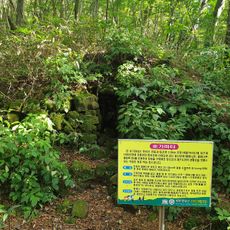
The caves can be visited through marked entrance points, with guided tours available in different languages at the visitor centers. Wear comfortable walking shoes and prepare for uneven surfaces, as the passages both above and below ground can be challenging underfoot.
The Geomunoreum Lava Tube System, formed by lava from eruptions of the scoria cone Geomunoreum tens of thousands of years ago, comprises five caves: Bengdwigul, Manjanggul, Gimnyeonggul, Yongcheondonggul and Dangcheomuldonggul. UNESCO calls it the finest lava tube cave system in the world, citing its series of stalactites and other mineral formations.
The community of curious travelers
AroundUs brings together thousands of curated places, local tips, and hidden gems, enriched daily by 93,478 contributors worldwide.