Suwon World Cup Stadium, Football stadium in Suwon-si, South Korea.
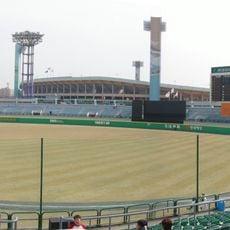
Suwon World Cup Stadium is a football ground in Suwon, South Korea, with a capacity of 44,031. Its wing-shaped roof covers the east and west stands, and the structure rests on a base modelled after Hwaseong Fortress. The stands are split into N, S, E and W sections over two tiers, with lower and upper slopes of 22.9 and 33.9 degrees.
Suwon applied to host the World Cup in September 1994, and Samsung founded the Suwon Samsung Bluewings in February 1995. Samsung Electronics proposed a football-only ground, and the city agreed in July 1996; the groundbreaking followed in November 1996. After Samsung withdrew in April 1998 during the economic crisis, Gyeonggi Province and Suwon formed a joint corporation on 3 March 2000 to finish the work. The stadium opened on 3 May 2001 with a friendly between Suwon High School and FC Barcelona's youth team, which the visitors won 3-1.
The stadium's nickname, Big Bird, comes from its large wing-shaped roof and from the Bluewings, the home team's name. The stands form a giant mosaic, and about 20,000 seats carry the names of Gyeonggi residents who donated to the 'one person, one chair' campaign when construction stalled.
The venue is easy to reach by public transport, with several bus routes in the area and railway connections available. Visitors should arrive early on event days to secure parking or arrange alternative transport options.
Four toilets outside the stadium are shaped like footballs eight metres across. The roof columns are unusually slender and held by V-shaped cables, the same design method used at the Stade de France in Saint-Denis. On rainy days water collects on the wing-shaped roof and falls in what fans call the Big Bird waterfall.
The community of curious travelers
AroundUs brings together thousands of curated places, local tips, and hidden gems, enriched daily by 94,459 contributors worldwide.