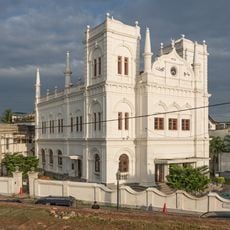
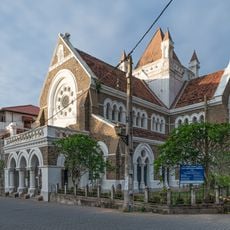
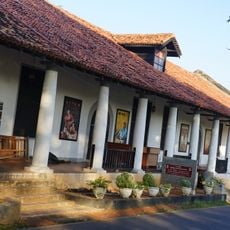
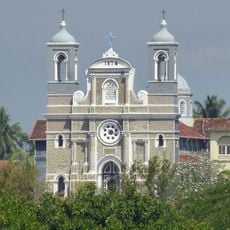
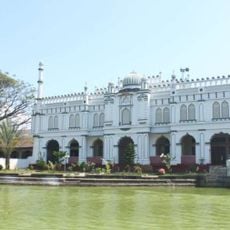
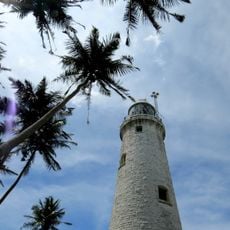
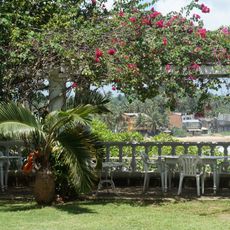
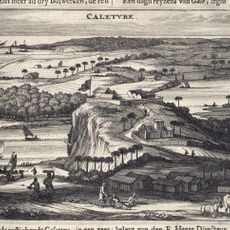
Sunandarama Vihara, Buddhist temple in Ambalangoda, Sri Lanka
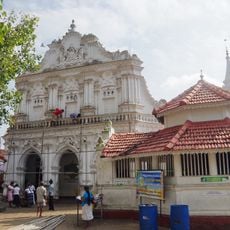
Sunandarama Vihara is a Buddhist temple complex of about 2 hectares in Ambalangoda, arranged on two tiers called maluwa. The lower tier holds the sermon hall, monastery, ordination area and alms hall; the upper tier holds the shrine, the sacred Bodhi and the statue house, the oldest building, from the Kandyan era.
The temple traces its origins to the 18th century, with a sacred Bodhi tree planted in the early 1700s. The main buildings were constructed later, establishing a religious site that grew and evolved across generations.
The murals follow the hill-country tradition, close to those sketched around 1805 at Thotagamu Vihara by an artist from Sathara Koralaya. They show Jataka tales such as Vessanthara, Sachchankira and Mandhathu, painted mainly in red, brown, black and blue. The recumbent and standing Buddha figures on the hall walls and ceiling are by P. N. Jakolis of Galle and two assistants.
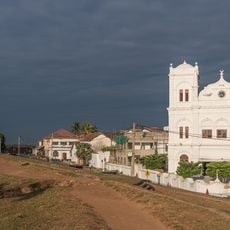
The temple sits about 200 m east of Ambalangoda railway station, and the complex is split into two tiers called Maluwa: the sermon hall, monastery and alms hall below, the shrine, Sacred Bodhi and statue house above. The bell arch stands 30 m high and 18 m wide, and its mechanical bell on the third floor works from a machine on the first floor. The Gehenna, a concrete structure with tunnels, lies on the eastern side.
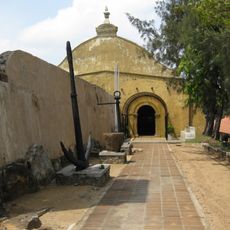
The bell arch is a concrete pandal 30 m high and 18 m wide, carved with security figures and Makara Thorana on four storeys. Begun in 1876 by Juanwanwadu Endoris De Silva and finished after his death in 1895 by his son, it took over 40 years to complete. Its base rests on a railway track, and a 250 kg mechanical bell on the third floor is worked from the first floor.
The community of curious travelers
AroundUs brings together thousands of curated places, local tips, and hidden gems, enriched daily by 94,109 contributors worldwide.