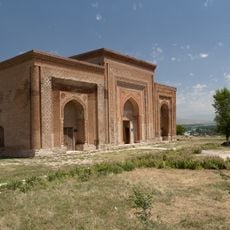
Afaq Khoja Mausoleum, Islamic mausoleum in Haohan Village, Kashgar, China.
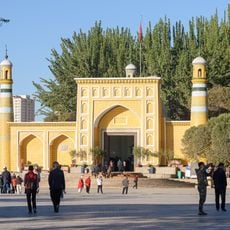
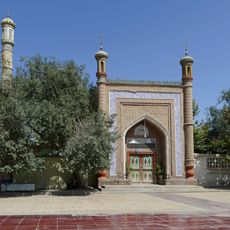
Afaq Khoja Mausoleum is a walled burial complex about 5 km northeast of Kashgar in Haohan Village. Its square tomb hall is crowned by a 17 m dome and flanked by four corner minarets with geometric windows and inverted lotus domes. The complex also contains four wooden-beamed prayer halls, a lecture hall, a gateway with blue glazed tiles, a courtyard pond and an active cemetery.
The mausoleum was first built around 1640 as the tomb of Muhammad Yusuf, a Naqshbandi Sufi master from Central Asia. His son Afaq Khoja, who died in 1694, was buried there as well. In the 1870s Yaqub Beg expanded the complex over four years, completing it in 1874. It became a National Key Cultural Relic in 1988.
The site is called Xiang Fei Tomb after a legend linking it to Iparhan, a Uyghur consort of the Qianlong Emperor, though the tomb actually belongs to the Afaqi family. The wooden prayer halls have muqarnas capitals, and pilgrims still use the courtyard pond for ablution before entering.
The site is located outside the city and requires personal transportation to reach it. Visiting in the early morning provides better light for photographs and a quieter experience.
The complex is surrounded by an active cemetery where new burials still take place in tombs made of mud and brick. This ongoing use reveals how the site continues to function as a living place of remembrance rather than just a museum piece.
The community of curious travelers
AroundUs brings together thousands of curated places, local tips, and hidden gems, enriched daily by 93,323 contributors worldwide.