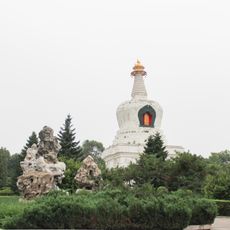
无垢净光舍利塔, Buddhist pagoda in Huanggu District, Shenyang, China
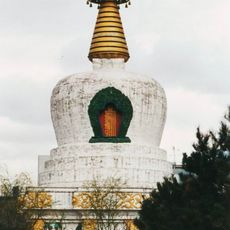
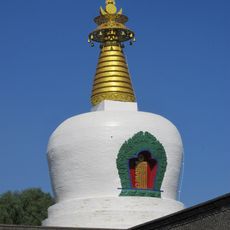
Wugou Jingguang Relic Pagoda is a 13-storey, octagonal brick pagoda over 30 metres tall, built on an octagonal Sumeru pedestal 5.5 metres wide on each face. Its eight sides each hold a niche with a seated Buddha and two attendants, and the spire ends in a gourd-shaped bronze finial. The structure comprises an underground palace, base, body, eaves and spire.
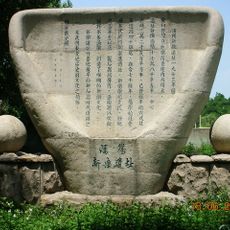
The pagoda was built in 1044, the 13th year of the Chongxi era of the Liao Dynasty, and was rebuilt in 1640, the fifth year of Chongde under the Qing. A stele set two metres south of the pagoda, the Record of the Reconstruction of the Wugou Jingguang Relic Pagoda, carries the account of both campaigns in Chinese, Manchu and Mongolian. Repairs in 1985 revealed a hollow body and a painted underground palace.
The pagoda gives its name to one of the old Eight Scenes of Shenyang, "Tawan Sunset", recorded in Qing poetry: a bay of water, the pagoda's shadow, and willows along the Xinkai River. The Qianlong Emperor is said to have written a verse on the view during his eastern tour to Shengjing.
The pagoda is at 15 Lane 45, Tawan Street, Huanggu District, beside the Xinkai River. The Shenyang Ancient Pagoda Relics Exhibition Hall stands on its north side, showing objects unearthed from Shenyang's pagodas. Buses 222, 223, 228 and 276 stop at Tawan Street.
The underground chamber beneath the structure went undiscovered until restoration work in 1985 revealed its existence and the colored murals within. These hidden artworks had been sealed away for centuries before being brought to light.
The community of curious travelers
AroundUs brings together thousands of curated places, local tips, and hidden gems, enriched daily by 94,003 contributors worldwide.