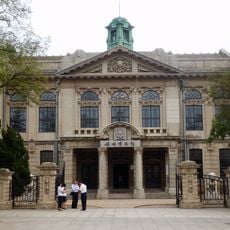
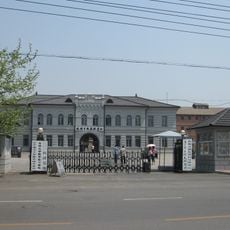
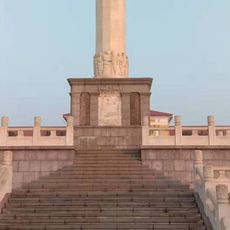
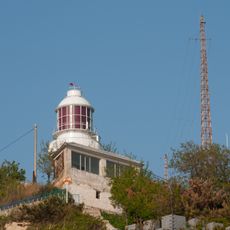
Port Lüshun, Naval port in Dalian, China
Port Lüshun is a deep-water harbor with multiple docks and terminals spread along the southern tip of the Liaodong Peninsula in northeastern China. The area is divided into a commercial section for cargo ships and a restricted military zone for the Chinese fleet.
Construction of the naval base began in the 1880s under Qing statesman Li Hongzhang for the Beiyang Fleet, with fortifications supervised by German Major Constantin von Gunneken; the dockyard was completed in September 1890. Japan took the port in November 1894 and, after the Triple Intervention, it passed to Russia in 1895. Russia held it until 1904, Japan from 1905 to 1945, and the Soviet Union from 1945 to 1956, when it returned to China.
The name Lüshun dates from 1371, when Zhu Di, later emperor, sent envoys to survey the coast and, because the journey went smoothly (lu shunli), gave the bay the name Lüshunkou, "bay of calm travels". The earlier name Shizikou, "Lion's jaw", came from a statue that now stands in a park beside the military port.
The port is divided into two distinct areas: a commercial section and a heavily restricted military zone that is off-limits to civilians. Visitors should check access restrictions beforehand and stay within authorized areas only.
The name Shizikou, or "Lion's Jaw", came from a statue that once stood by the military port; the statue is now kept in a nearby park. The bay's inner roadstead and entrance were dredged to a depth of 20 feet (6.1 m) in the Qing era.
The community of curious travelers
AroundUs brings together thousands of curated places, local tips, and hidden gems, enriched daily by 94,975 contributors worldwide.