Former site of the Kwantung Army headquarters, Military headquarters site in Guangrong Subdistrict, Dalian, China.
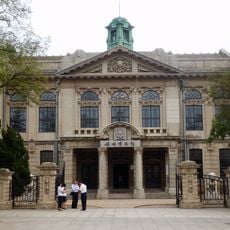
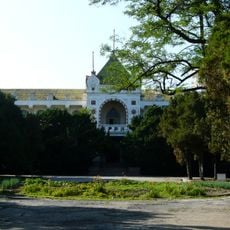
The former Kwantung Army headquarters is a two-storey European-style building at 18 Xinhua Street in Lushunkou District, Dalian, facing south with 2,602 square metres of floor space. It was built in 1903 by Tsarist Russia as the office of the Russian Kwantung Oblast artillery department. Since 2004 it has housed a museum of the Kwantung Army headquarters site.
The two-storey building was put up in 1903 by Tsarist Russia as offices for the artillery department of the Kwantung Oblast army. After Japanese forces took Lüshun, the Kwantung Government-General was set up here on 18 October 1905 and renamed the Kwantung Government on 1 September 1906, with this building housing its army department. The Kwantung Army headquarters was created here on 12 April 1919 and planned the Mukden Incident in 1931; it moved to Shenyang on 19 September 1931 and to Xinjing on 30 October 1932, after which the building became an army hospital.
The building's name comes from the Kwantung Army, whose headquarters was set up here on 12 April 1919. From this site the army planned the Mukden Incident in 1931, and the building later became its military hospital. Since 2004 it has housed a museum on the Kwantung Army headquarters.
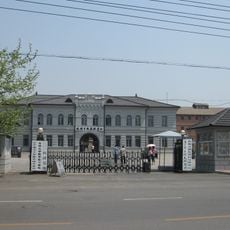
The building stands at No. 18 Xinhua Street in the Xinhua community of Guangrong Subdistrict, Lushunkou District, Dalian. It is a two-storey European-style structure facing south, with 2,602 square metres of floor space. It has housed the Kwantung Army headquarters museum since 2004.
The building was not built for the Japanese army: the two-storey European-style structure went up in 1903 for the Russian artillery department of the Kwantung Oblast. Japan took it over after occupying Lüshun, and on 18 October 1905 the Kwantung Governor-General's Office was set up inside.
The community of curious travelers
AroundUs brings together thousands of curated places, local tips, and hidden gems, enriched daily by 93,115 contributors worldwide.