Kyū Yasuda Garden, Japanese strolling garden in Yokoami, Tokyo, Japan
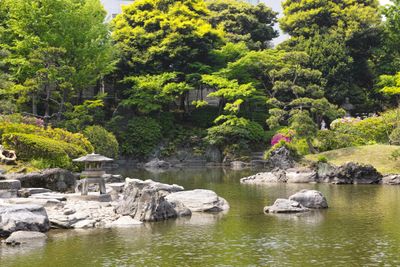
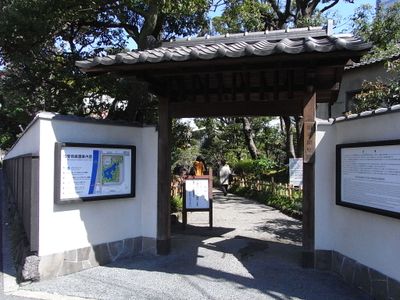
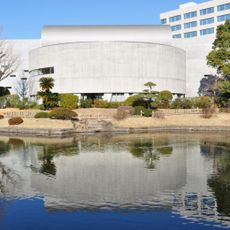
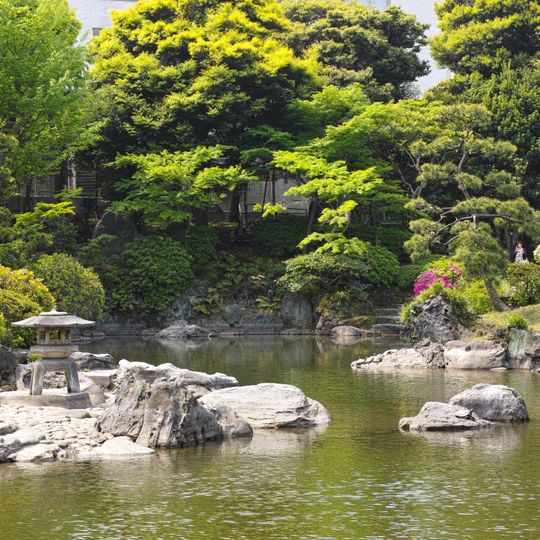
Kyū Yasuda Garden is a daimyō strolling garden in Yokoami, Tokyo, arranged around a heart-shaped pond with small islands, bordered by old trees and a walking path. A snow-viewing stone lantern stands at the water's edge, and the pond is home to carp and turtles. Pale gray rocks emerge from the greenish-brown water, and a rocky shoreline curves along the far side. The entrance is a dark wooden gate with a tiled roof and a small plaque on the right post, set between white plaster walls.
The garden was laid out in the Genroku era (1688–1704) by Honjō Munesuke as the lower residence of the Honjō Matsudaira, lords of Kasama and later Miyazu. In the Ansei era it was reworked as a tidal strolling garden drawing water from the Sumida River. The Yasuda family donated it to Tokyo City in 1922; after the 1923 Kantō earthquake it was restored and reopened in 1927.
The Kyū in the name means "former", marking the garden's change from a daimyō residence to public ground. Three stones and a ginkgo near the pond are called Komadome: tradition says Abe Bungo-no-kami tied his horse there in 1631 while watching the Sumida flood. Stone tablets in the garden carry haiku by Matsuo Bashō and Jindō Unnan.
Admission is free, and the paths are level enough for a slow walk, though some sections can be uneven. The garden closes later in summer than in winter, so visiting in the morning or early afternoon works well year-round.
A hidden pump system mimics the tides, raising and lowering the pond level throughout the day. River water once flowed directly in, but now machinery replaces the natural link to the Sumida.
The community of curious travelers
AroundUs brings together thousands of curated places, local tips, and hidden gems, enriched daily by 93,442 contributors worldwide.