Tokyo Memorial Hall, Memorial building in Yokoamichō Park, Japan
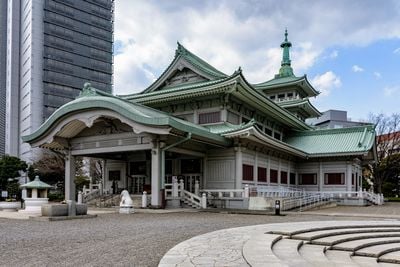
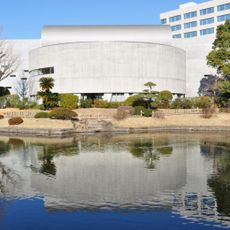
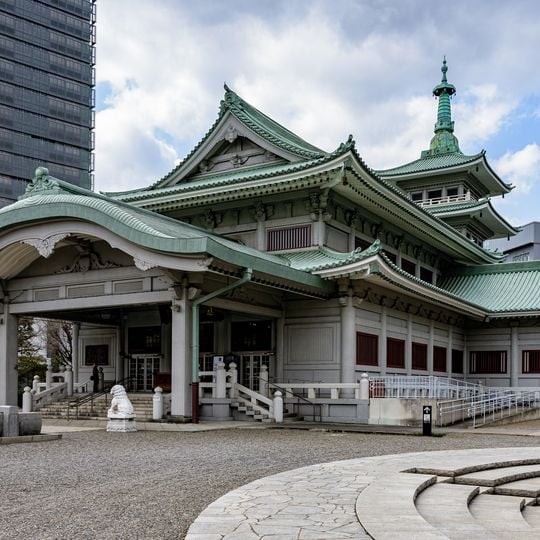
Tokyo Memorial Hall is a reinforced-concrete hall in Yokoamichō Park, completed in 1930 to designs by Itō Chūta and three other engineers. Its pale grey walls carry a multi-tiered green copper roof with curved eaves, and a square tower on the right holds a tall green finial. A columned porch and a stair with white railings lead to glass doors, with a stone lion beside the steps. Behind the hall stands an irregular five-storey memorial tower, 41 m high, whose base is an ossuary.
Architect Itō Chūta completed this memorial structure in September 1930 to honor those who lost their lives in the Great Kanto Earthquake. The building was created in response to the 1923 earthquake and became an important place of remembrance for its victims.
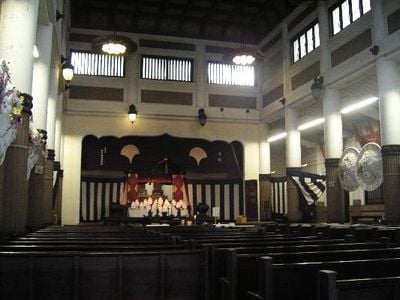
The hall is run by the Tokyo Metropolitan Memorial Association and is used for Buddhist rites: two great memorial services are held each year, on 10 March for the Tokyo air raids and on 1 September for the Great Kanto Earthquake. Inside, two large tablets stand before the altar, the right one for earthquake victims and the left for war dead. The bell in the grounds, the Muyō bell, was donated by a Buddhist group from the Republic of China.
The hall stands inside Yokoamichō Park, about five minutes on foot from Ryōgoku Station on the JR Sōbu Line and the Toei Ōedo Line; Kuramae Station on the Toei Asakusa Line is reached via Kuramae Bridge. There is no car park. The two annual ceremonies are held on 10 March, the date of the 1945 Tokyo air raid, and 1 September, the date of the 1923 earthquake.
The building blends Buddhist temple architectural elements with modern structural techniques developed in the early 20th century. This unusual mix of different style influences makes it a notable example of the transition period in Japanese architecture.
The community of curious travelers
AroundUs brings together thousands of curated places, local tips, and hidden gems, enriched daily by 93,549 contributors worldwide.