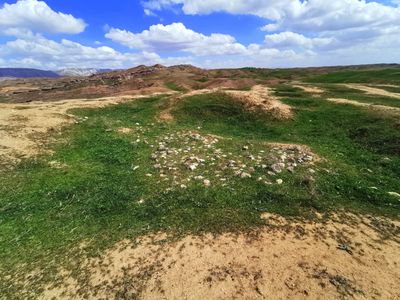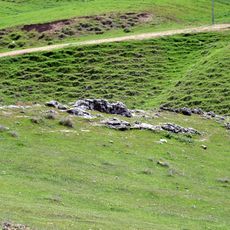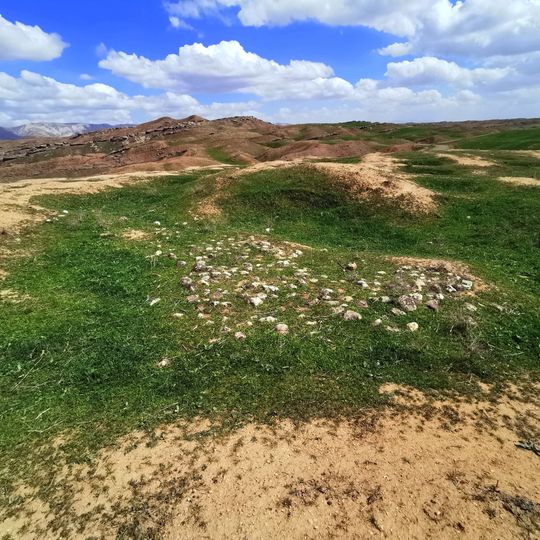
Jarmo, Archaeological settlement in Chamchamal, Iraq
Jarmo is an archaeological settlement in Chamchamal, Iraq, located at an altitude of 800 meters amid pistachio and oak forests. The remains extend over roughly 16,000 square meters and include foundations of about 25 dwellings along with tools and storage vessels from the Neolithic period.
The Iraqi Directorate of Antiquities found Jarmo in 1940; Robert Braidwood of the University of Chicago Oriental Institute then excavated it in 1948, 1950–51 and 1954–55, dating the oldest levels by carbon-14 to 7090 BC and the latest to 4950 BC. A planned 1958–59 campaign was cancelled after the 14 July Revolution. In 2012 a University College London team resumed digging.
The site's name appears in Kurdish as Çermo or Qelay Çermo and in Arabic as Qal'at Jarmū. Excavated clay figures include zoomorphic and anthropomorphic forms, among them pregnant women interpreted as fertility goddesses, an early stage of Mesopotamian art. Handmade thick-walled pottery treated with a vegetable solvent marks the latest levels.
Jarmo lies on the foothills of the Zagros near Chamchamal, between Kirkuk and Sulaymaniyya, at about 800 m altitude in oak and pistachio woodland. The excavated area covers 12,000 to 16,000 m², so allow time to walk the slope and the twelve levels. A 2012 University College London team began new excavations, so parts of the mound may be fenced or closed.
Archaeologists found stone sickles and cutting tools that show how people moved from hunting to grain cultivation. These implements also prove that residents already gathered wild cereals before they began to cultivate them deliberately.
The community of curious travelers
AroundUs brings together thousands of curated places, local tips, and hidden gems, enriched daily by 92,597 contributors worldwide.