Kabul hoard, Coin hoard in Kabul, Afghanistan
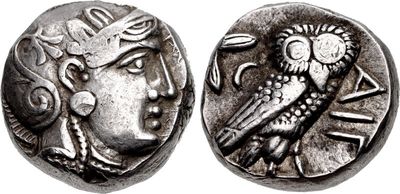
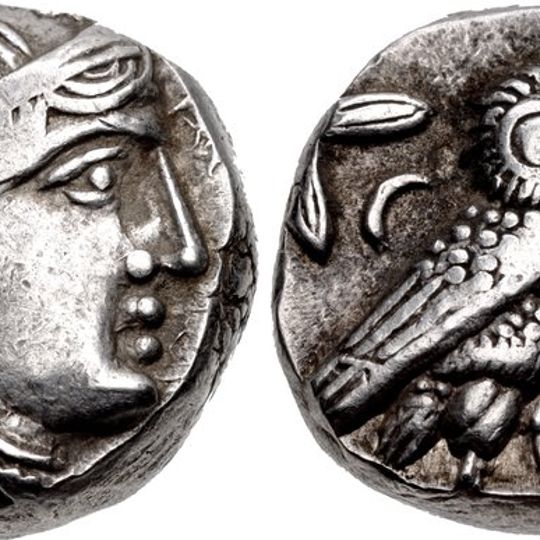
The Kabul hoard is a group of about 1,000 silver coins and some jewellery found in 1933 during foundation digging near Chaman-i Hazouri park in central Kabul. Daniel Schlumberger later described 115 coins kept in the Kabul Museum: 30 from various Greek cities, about 33 Athenian plus one Iranian imitation, 9 Achaemenid sigloi, 29 locally minted coins of a "new kind", and 14 punch-marked coins shaped as bent bars. The photograph shows two thick silver pieces with raised rims: one bears a forward-facing head with a long straight nose and four pellets on the cheek, the other a bird with a curved beak and a wing marked by parallel lines.
The hoard was buried around 380 BCE, the date of its latest datable coin, a local imitation of an Athenian owl tetradrachm. Daniel Schlumberger later published 115 of the coins kept in the Kabul Museum: 30 from various Greek cities, about 33 Athenian pieces plus one Iranian imitation, 9 Achaemenid sigloi, 29 locally minted coins of a "new kind" and 14 punch-marked bent bars. The coins were lost when the museum was plundered in 1992–1993; 14 resurfaced in a private collection in Pakistan.
The hoard's 14 punch-marked coins, bent bars rather than round discs, are central to a debate: numismatist Joe Cribb argues the technique reached India from the Achaemenid Empire in the 4th century BCE, while many Indian scholars see coinage in the Gangetic plains as an indigenous development. The two silver pieces shown here, a head with four pellets and a bird with a leaf sprig, are locally minted coins of a "new kind".
The hoard no longer exists as a find: the coins kept at the Kabul Museum were plundered in 1992–1993, and only 14 pieces later surfaced in a private collection in Pakistan. The findspot lay near Chaman-i Hazouri park in central Kabul, where a construction team was digging foundations in 1933. What can be consulted today are Schlumberger's published photographs and descriptions of 115 coins.
The collection includes archaic staters from Aegina and Thasos, ancient coin types from Mediterranean islands. These pieces show that Greek money was already moving through this region long before Alexander's campaigns into Asia.
The community of curious travelers
AroundUs brings together thousands of curated places, local tips, and hidden gems, enriched daily by 93,898 contributors worldwide.