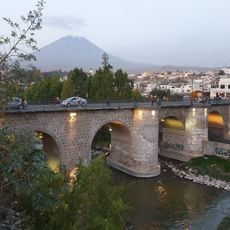
Puente de Fierro, 19th-century bridge in Arequipa, Peru.
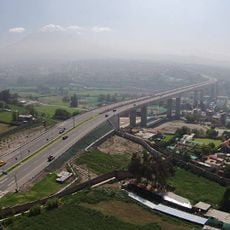
The Puente de Fierro, officially Puente Bolívar, is a 484.6 m iron bridge over the Chili River in central Arequipa. It is made of 53 Fink trusses, each 30 ft (9.14 m) long, supported by Phoenix Columns and four slender piers, with a 120 ft main span over the river. A 5 m reinforced concrete deck with asphalt was added in 1960.
Built under contracts Henry Meiggs signed with Peru in 1869, the iron bridge opened on 1 January 1871 with the 170 km Matarani–Arequipa line of the Southern Railway. It carried the first bridge of the next stretch toward Juliaca, opened in 1873, moving people and materials for that construction. The last train crossed in 1920, after a stronger bridge was built 1.5 km downstream.
The bridge is often attributed to Gustave Eiffel, but it was actually planned and built by Charles Shaler Smith and his Baltimore Bridge Co., using patented Fink trusses and Phoenix Columns from the Phoenix Iron Co. Local lore linking it to Eiffel persists among residents, and the ironwork is a point of civic pride in Arequipa.
The bridge carries a single-lane roadway with two footpaths, crossed one-way from northwest to southeast over the deep Río Chili valley. Its 53 identical 30 ft (9.14 m) truss sections rest on Phoenix Column piers, with a 120 ft (36.6 m) span over the river. The western end meets an abutment set into the steep slope; the eastern end continues into a short ramp.
The bridge was designed by a specialist who patented a novel column system that was used in only a handful of similar structures worldwide. Today it stands as one of the last remaining examples of this specific construction method.
The community of curious travelers
AroundUs brings together thousands of curated places, local tips, and hidden gems, enriched daily by 93,779 contributors worldwide.