Huaca Huallamarca, Pre-Columbian pyramid in San Isidro, Peru.
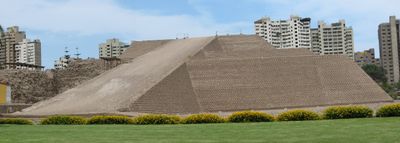
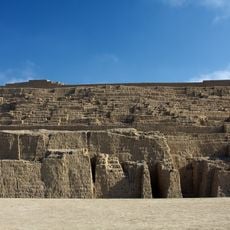
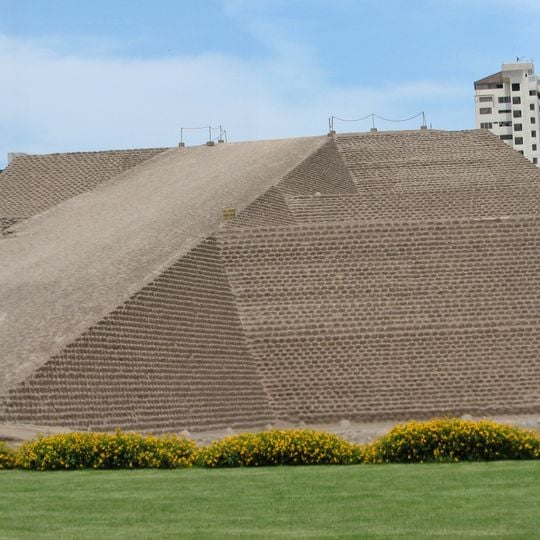
Huaca Huallamarca is a truncated stepped pyramid of three levels rising about 19 metres, built in San Isidro, Lima. Its walls are made of small handmade adobe bricks shaped like corn kernels or irregular cones, laid in disordered rows. A wide earthen ramp climbs the front, and the sloping face beside it shows rows of raised rounded adobe blocks.
Built from around 200 BC by the Huallas, the pyramid served as a ceremonial and administrative centre. It was later abandoned and reused as a cemetery, with burials of the Lima, Huaura, Sicán, Chincha and Ychsma cultures, a use that continued into the Inca period around 1476 AD. Julio C. Tello began the first excavations in 1942; in 1958 Arturo Jiménez Borja and Jorge Zegarra Galdós excavated the summit and recovered 48 funerary bundles, which led to the restoration.
The name Huallamarca was given by archaeologist Julio C. Tello, combining Quechua walla, the Huallas tribe, and marka, village: "Town of the Huallas". Until the early 20th century it was publicly called Pan de Azúcar, after the sugar-loaf shape of its adobe stones. The site museum, opened on 8 August 1960, was the first of its kind in Peru.
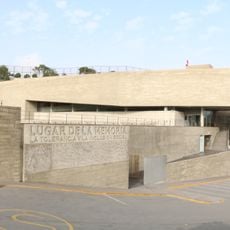
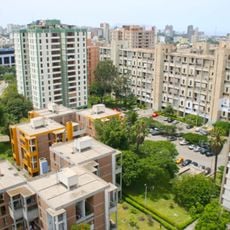
Access is straightforward since the site sits in a residential neighborhood and is reachable on foot. A small museum adjacent to the pyramid provides information about the finds and the history of the place.
The pyramid was built with small handmade adobes shaped like corn kernels or irregular cones, not rectangular blocks. Archaeologist Julio C. Tello noted their imprint of the makers' palms, a trait of the Pinazo tradition, which shows the structure predates the Lima culture in the valley.
The community of curious travelers
AroundUs brings together thousands of curated places, local tips, and hidden gems, enriched daily by 93,469 contributors worldwide.