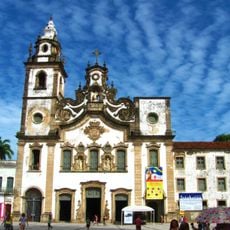
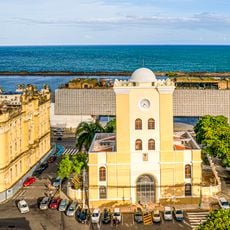
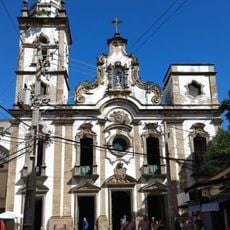
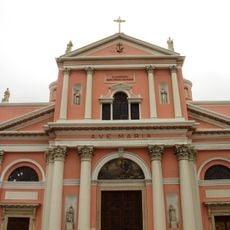
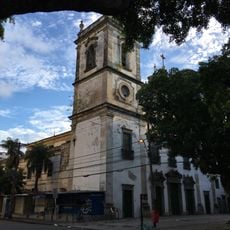
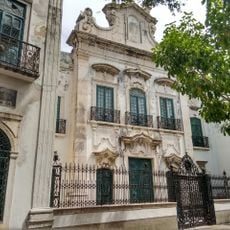
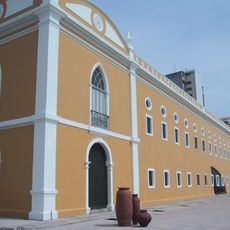
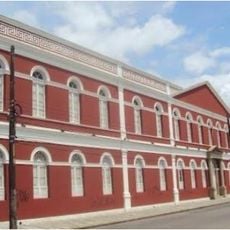
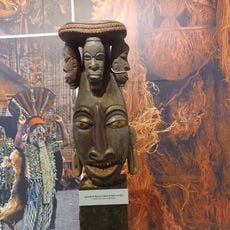
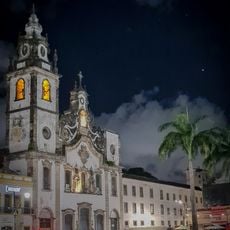
Convent and Church of Santo Antônio, Religious complex in Recife, Brazil.
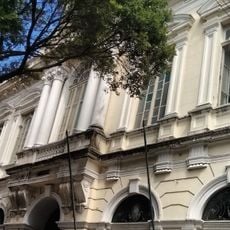
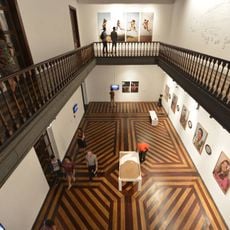
The Convent and Church of Santo Antônio form a religious complex in Recife with baroque architecture and elaborate ornamentation, particularly within the Capela Dourada chapel. The interior displays rich decorative elements that unfold across multiple spaces.
Franciscan friars founded the convent on 28 October 1606 on the Ilha dos Navios, on land of 56 braças donated by the sugar-mill owner Marcos André; an oratory with an attached hospital was recorded as finished in 1613. Under Dutch rule the building became the Forte Ernesto, with walls and bastions, and later served the Anglican Church for officials of the West India Company. After the Dutch left it returned to the Franciscans, who restored it and added an infirmary.
The church keeps panels of azulejos showing scenes from the life of Santo Antônio along its side walls, and the convent cloister holds biblical scenes such as the Flood and the sacrifice of Isaac. A frieze of about 900 tiles, each with its own figure and dated 1630–1650, is thought to come from the old Forte Ernestus and Maurits van Nassau's Palácio de Friburgo.
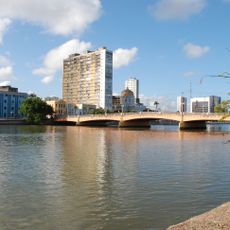
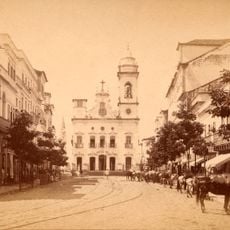
The complex sits in the Santo Antônio neighbourhood on the Ilha de Antônio Vaz, the island where the friars began building in 1606. The church opens onto the Largo do Convento; the Capela Dourada is reached through a large grilled arch on the left of the nave. A small cemetery with a stone cross from 1840 lies behind the sacristy.
The Capela Dourada, attached to the church and separated from the nave by a large grilled arch, is described in the sources as the first temple in Brazil to be entirely covered in baroque decoration. Behind the sacristy, which holds 18th-century furniture with silver ornament by carver José Gomes de Figueiredo, a small cemetery has a stone cross erected in 1840.
The community of curious travelers
AroundUs brings together thousands of curated places, local tips, and hidden gems, enriched daily by 92,814 contributors worldwide.